
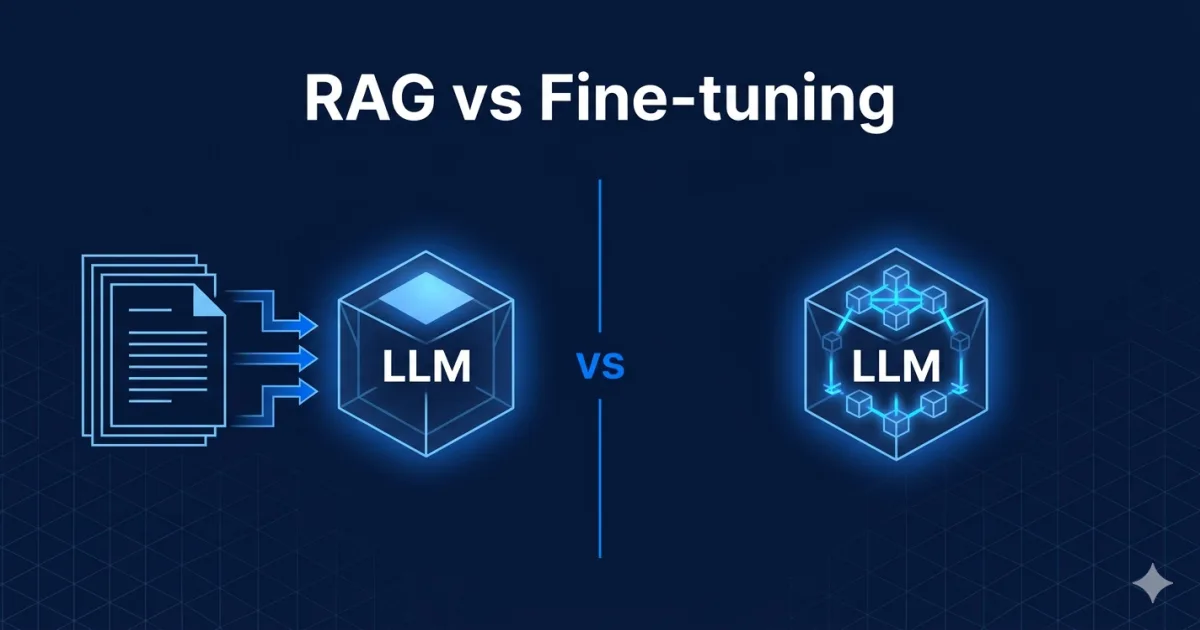
Every enterprise AI project eventually asks the same question: should we use retrieval-augmented generation or fine-tune a model on our data? The answer is not "RAG is cheaper" or "fine-tuning is more accurate." Both of those are slogans, not decisions. The right answer depends on what the model is missing: knowledge, or behavior.
What each one actually does
RAG gives the model access to external documents at query time. You embed your knowledge base, retrieve the most relevant chunks for each user question, and include those chunks in the prompt. The model reasons over content it did not see during training.
Fine-tuning updates the model's weights by training it on examples of input and desired output. The model internalizes patterns, style, or domain-specific reasoning.
The key mental model: RAG is about what the model knows. Fine-tuning is about how the model behaves. Most teams reach for fine-tuning when they should use RAG, because fine-tuning feels more sophisticated.
Use RAG when knowledge is the bottleneck
Reach for RAG when:
- Your data changes often. Product docs, support tickets, policy changes, internal wikis. Fine-tuning freezes a model at a point in time. RAG stays current.
- You need citations. Enterprise users want to click through and see the source. Only retrieval can give you that. Fine-tuning cannot show its work.
- You have a lot of documents. Tens of thousands of pages is trivial for a vector database, expensive for fine-tuning.
- You need access control. Different users should see different documents. RAG can filter retrieval per user. Fine-tuning bakes everything into the model permanently.
This is why most enterprise chatbot, support, and knowledge-assistant projects are RAG projects, not fine-tuning projects. The problem is almost always "the model does not know our stuff," not "the model does not write in our voice."
Use fine-tuning when behavior is the bottleneck
Reach for fine-tuning when:
- You need a specific output format consistently. Extracting structured JSON from messy inputs, classifying tickets into your taxonomy, generating code in a house style. Fine-tuning teaches the format more reliably than prompting.
- You need to reduce prompt length. If you are shipping the same 2,000-token system prompt on every request to enforce behavior, fine-tuning can absorb that into the weights and cut your per-query cost dramatically.
- You need domain-specific reasoning patterns. Medical triage, legal contract review, engineering design review. The model needs to think like a domain expert, not just retrieve expert-written text.
- Latency matters more than recency. Fine-tuned models can skip the retrieval roundtrip and run faster and cheaper at steady state.
The decision tree we use
When a client asks us which approach to use, we work through four questions in order:
1. Does the data change? If yes, you need RAG (or RAG plus fine-tuning). You cannot keep re-fine-tuning on a weekly cadence.
2. Do users need citations? If yes, RAG. Full stop.
3. Is the model failing because it does not know something, or because it does not know how to respond? Run 20 failing examples. If the right answer was in a document the model never saw, you need RAG. If the model had all the info and still got the format or tone wrong, you need fine-tuning.
4. Is prompt cost a real budget issue? If your prompts are long and call volume is huge, fine-tuning can pay for itself in months. Otherwise keep prompt engineering.
When you need both
Mature enterprise AI systems often use both. Fine-tune the model on your domain's reasoning patterns and response style, then layer RAG on top to inject the current, user-specific knowledge. A legal AI assistant might fine-tune to reason like a contracts lawyer and retrieve the specific contract being reviewed. Neither approach alone would be as effective.
This is the pattern we see most often in production deployments we work on through our dedicated RAG and AI developer engagements. Start with RAG. Measure where the model still fails on behavior, not knowledge. Then fine-tune selectively to close that gap. The framework layer is usually LlamaIndex or LangChain depending on how retrieval-heavy your system is.
The cost reality
RAG is almost always cheaper to start. You avoid GPU training costs, you can iterate on your corpus in minutes, and you can switch underlying models easily when a better one ships. Fine-tuning locks you into the base model you trained on, and re-training is expensive enough that most teams do it once and hope it still works six months later. If you are building an AI MVP on a tight timeline, default to RAG unless you have a specific reason otherwise.
The shortest version
Use RAG when the model needs access to information it does not have. Use fine-tuning when the model needs to behave differently than it does out of the box. Use both when you need both. And before committing to either, run 20 failing examples and ask whether the failure is about knowledge or behavior. That single exercise saves most teams a quarter of wasted engineering. If you want a second opinion on which path fits your use case, get in touch.