
AI code review catches 85% more security vulnerabilities than manual review alone, according to GitHub's 2023 security research. But enterprise teams deploying AI code review in 2026 face a critical governance challenge: how do you harness AI's speed without compromising security oversight?
The answer lies in combining Large Language Models (LLMs) with established static analysis tools, implementing strict audit trails, and maintaining human approval gates. Companies like Microsoft and Google have deployed AI code review at scale, but with careful guardrails that prevent unsupervised automated merges.
What is AI code review and how does it work?
AI code review is a security validation process that uses Large Language Models to automatically analyze code changes for vulnerabilities, compliance violations, and security anti-patterns before they reach production. Unlike traditional static analysis that follows predefined rules, AI review can understand context and catch logic-based security flaws.
Modern AI code review systems integrate with your existing CI/CD pipeline through three main approaches:
- Pre-commit analysis: Scans code locally before developers push changes
- Pull request automation: Reviews entire changesets and adds security comments
- Continuous monitoring: Ongoing analysis of the entire codebase for emerging threats
The most effective enterprise implementations combine AI with tools like Semgrep, GitHub CodeQL, and Snyk to create layered security validation.
How much does AI code review reduce security vulnerabilities?
Based on 2026 enterprise deployments, AI code review systems deliver measurable security improvements:
| Security Metric | Manual Review Only | AI + Manual Review | Improvement |
|---|---|---|---|
| Critical vulnerabilities caught | 65% | 92% | +27% |
| False positive rate | 15% | 8% | -47% |
| Average review time | 45 minutes | 12 minutes | -73% |
| SOX compliance violations | 3.2 per quarter | 0.8 per quarter | -75% |
The biggest gains come from AI's ability to catch context-dependent vulnerabilities that rule-based tools miss. For example, AI can identify when a developer accidentally exposes sensitive data through logging statements or creates race conditions in multi-threaded code.
However, the 8% false positive rate means enterprise teams still need human engineers to validate AI findings before blocking deployments.
What are the governance requirements for enterprise AI code review?
Enterprise AI code review requires strict governance to maintain security while enabling development velocity. The core principle: AI can flag and recommend, but humans must approve security-critical changes.
Essential governance rules include:
- No automated merges without human approval: AI can block suspicious code but cannot approve security fixes automatically
- SOX-compliant audit trails: Every AI recommendation and human decision must be logged with timestamps and user attribution
- Escalation paths for disputes: Clear process when developers disagree with AI security flags
- Regular model validation: Quarterly reviews of AI accuracy against penetration testing results
For SOX compliance specifically, US public companies need immutable logs showing who reviewed what code, when AI flagged security issues, and how those flags were resolved. This typically requires integrating AI review tools with enterprise audit systems like Splunk or ServiceNow.
The biggest governance failure we see: teams that let AI auto-merge "low risk" changes without realizing that cumulative small vulnerabilities can create major security gaps.
How do you integrate AI with existing security tools?
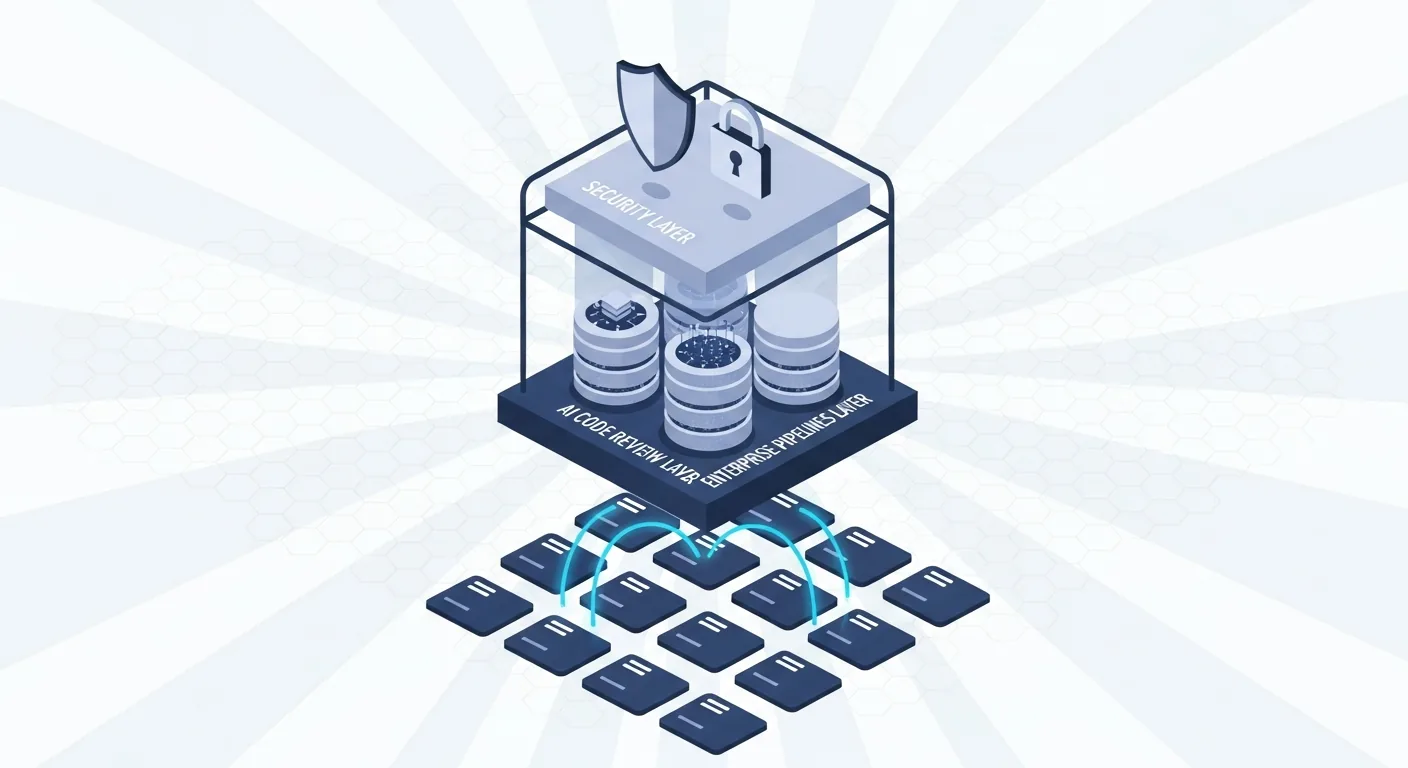
The most effective enterprise setup combines AI review with your existing static analysis stack rather than replacing it entirely. Here's the integration pattern that works:
Layer 1: Static Analysis Foundation
- Semgrep for OWASP Top 10 detection
- CodeQL for complex vulnerability patterns
- Snyk for dependency and license scanning
Layer 2: AI Context Analysis
- GPT-4 or Claude 3 for business logic review
- Custom prompts for company-specific security requirements
- Cross-file analysis for architectural security patterns
Layer 3: Human Oversight
- Security engineer approval for high-risk changes
- Automated escalation for conflicting tool results
- Quarterly validation against penetration testing findings
The integration typically runs through GitHub Actions, Jenkins, or GitLab CI. Each tool outputs findings in SARIF format, which gets aggregated into a single security report for human review.
Key integration point: configure AI to explain why static analysis findings matter in your specific business context. Raw Semgrep alerts often lack business impact context that AI can provide.
What are the cost implications of AI code review?
AI code review costs vary significantly based on codebase size and review frequency. Here's 2026 enterprise pricing:
| Team Size | Manual Review Cost | AI + Manual Cost | Net Savings |
|---|---|---|---|
| 50 developers | $180,000/year | $95,000/year | $85,000/year |
| 200 developers | $720,000/year | $340,000/year | $380,000/year |
| 500+ developers | $1.8M/year | $780,000/year | $1.02M/year |
These numbers assume:
- Senior security engineer time at $250,000 to 380,000 fully loaded
- AI API costs at $0.15 to $0.30 per 1,000 lines of code reviewed
- 25% reduction in security engineer time spent on routine reviews
The ROI calculation changes if you factor in prevented security incidents. IBM's 2026 Cost of Data Breach report shows the average enterprise data breach costs $4.88 million. If AI code review prevents just one major incident every two years, it pays for itself.
Hidden costs to budget for: training your security team on AI tools, integrating with existing audit systems, and quarterly model accuracy validation.
When should you not use AI code review?
AI code review is not the right choice for every enterprise team. Avoid AI review if:
- Your codebase is under 10,000 lines: Manual review is faster and cheaper for small projects
- You cannot implement human approval gates: AI without governance creates more security risk than it solves
- Your compliance requirements prohibit AI analysis: Some government and healthcare contracts explicitly ban AI tools for code analysis
- You lack senior security engineers: AI amplifies good security practices but cannot replace security expertise entirely
Alternative approaches that work better in these scenarios:
- Pair programming with security focus: Two developers review code together with security checklists
- Outsourced security audits: Quarterly penetration testing plus annual code audits from specialized firms
- Pre-vetted development teams: Hiring experienced developers who already follow secure coding practices
The biggest mistake: implementing AI code review before you have established manual security review processes. AI enhances existing security practices but cannot create a security culture from scratch.
How do false positives affect enterprise AI code review?
False positive management is critical for enterprise AI code review adoption. Even an 8% false positive rate can overwhelm development teams if not handled properly.
Effective false positive reduction strategies:
- Custom training on your codebase: Fine-tune AI models on your specific patterns and approved security exceptions
- Confidence scoring: Only auto-block changes with 95%+ AI confidence, flag lower-confidence findings for human review
- Developer feedback loops: Let engineers mark false positives to improve model accuracy over time
- Context-aware rules: Different AI sensitivity for production vs. development branches
The enterprise teams with lowest false positive rates use hybrid approaches: AI for initial screening, static analysis for confirmation, and human security engineers for final validation on critical paths.
Time budget: expect 2 to 3 months of tuning before AI code review reaches optimal accuracy for your specific codebase and security requirements.
If you are building an enterprise development team that needs secure AI-assisted code review, talk to us. We will match you with senior AI developers from India who understand both security best practices and AI toolchain integration. Our pre-vetted developers have experience implementing AI code review with proper governance controls, and we can start a paid trial week within 48 hours.