
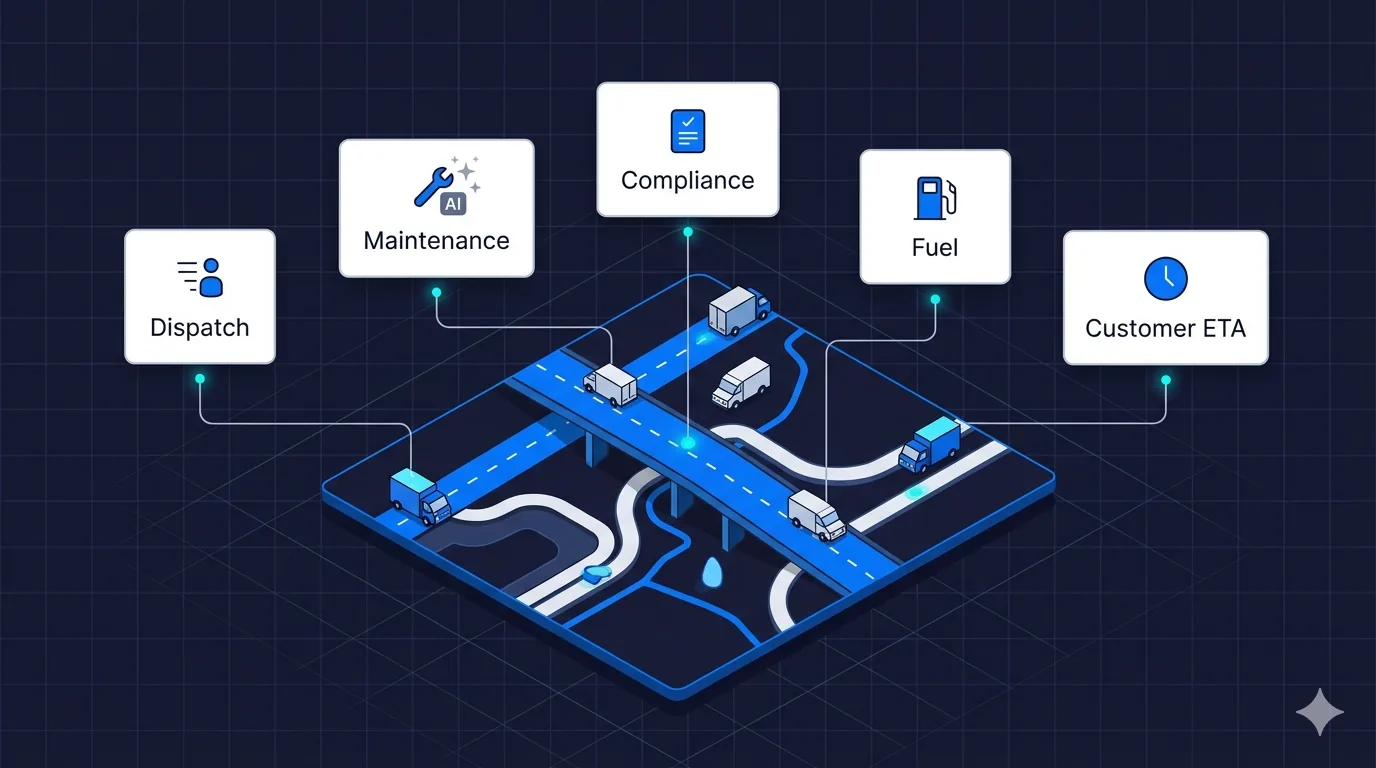
If you run a fleet between 25 and 500 vehicles, this post is for you. The honest version of where AI workflow automation actually helps fleet operators, where it does not, what it costs to build, and what it gives back. Mostly written for ops directors and CFOs at trucking, last-mile delivery, equipment rental, and field service companies who have looked at vertical SaaS and walked away because it does not fit how their business actually runs.
If you want to skip to the engagement model, see our automation consultants page. If you want to see how this looks for a different vertical first, our staffing agency case study walks through the same five-workflow pattern in a different industry.
Why fleet operations are an unusually good fit for AI plus workflow automation
Fleet ops has three properties that make it ripe for automation. First, the data exists. Telematics platforms like Samsara, Geotab, and Motive emit clean, real-time event streams: location, speed, idle, harsh braking, fault codes, fuel level. ELD providers emit hours of service data. Maintenance platforms like Fleetio emit work order and inspection data. The hard part of automating in most industries, which is getting the raw data, is already done.
Second, the work is repetitive and high volume. A dispatcher at a 100-truck operator handles roughly 250 to 400 events per day: load assignments, route changes, breakdowns, driver questions, customer ETA asks, exception handling. That volume is exactly what AI plus n8n is good at: read the event, classify it, route it, sometimes draft a response, escalate the small minority that needs a human.
Third, vertical SaaS has gaps. Samsara is great at telematics but does not run your maintenance workflow the way you want it. Fleetio is great at maintenance but does not talk to your customer portal. Motive is great at ELD but does not reconcile fuel cards. Every fleet operator we have worked with runs four to seven systems that do not natively talk to each other, and the glue between them is recurring human work. That glue is what automation replaces.
What workflows actually pay back, ranked by ROI
We have built fleet automation for trucking, last-mile, and equipment rental customers. The pattern of what pays back fastest is consistent. Below is the list in order, with realistic time savings for a 100-vehicle operator. Smaller fleets see proportionally smaller raw numbers but similar payback windows because dispatcher and back-office costs scale with vehicles.
| Workflow | Hours saved per week (100 vehicles) | Build complexity | Typical build cost (USD) |
|---|---|---|---|
| Dispatch triage and load assignment | 25 to 40 | Medium | 1,500 to 3,000 |
| Predictive maintenance scheduling | 15 to 25 | Medium | 1,200 to 2,500 |
| Driver compliance and HOS exception handling | 10 to 18 | Low to medium | 800 to 1,800 |
| Fuel and toll reconciliation | 8 to 15 | Low | 600 to 1,200 |
| Customer ETA and proactive comms | 6 to 12 | Low to medium | 800 to 1,500 |
| Total (full bundle) | 60 to 120 | - | 4,900 to 12,000 |
The full bundle is roughly USD 5,000 to USD 12,000 to build, and frees up the equivalent of 1.5 to 3 dispatchers worth of time per week. At a US dispatcher loaded cost of USD 35 to USD 50 per hour, that is USD 110,000 to USD 280,000 of annual labor value at the high end. Payback is typically 30 to 60 days. The detailed breakdown of each workflow follows.
How does dispatch triage and load assignment actually work?
This is the highest-ROI workflow we build for fleet customers. The pattern: every inbound load request, route change, or driver question arrives somewhere (email, SMS, customer portal webhook, EDI feed from a 3PL broker). An n8n workflow listens to all those channels, normalizes the message, and asks an AI model to classify it.
Claude or GPT reads the message and emits a structured decision: what type of event is this, what is the urgency, which dispatcher or driver should it go to, what data needs to be pulled from the telematics platform before a human looks at it. For 60 to 75 percent of events, the AI can take the entire action: assign the load to the nearest qualified driver based on hours-of-service availability, vehicle type, current location, and ETA. The dispatcher gets a Slack message that says "Auto-assigned load 4719 to driver Jim, ETA 14:20, confirm or reject."
For the remaining 25 to 40 percent of events, the AI prepares a recommendation with all the context (driver status, vehicle status, customer notes, similar past loads) and routes it to the dispatcher Slack channel with one-click accept/reject buttons. The dispatcher reviews and acts in seconds instead of minutes.
What it does not do: it does not replace the dispatcher. Edge cases, customer relationships, and judgment calls still need a human. What it does: it cuts the dispatcher's per-event time from 4 to 6 minutes down to 30 to 90 seconds, which is the difference between burnout and a manageable shift.
Why predictive maintenance is more about scheduling than prediction
"Predictive maintenance" gets oversold. The honest version: most fleet operators do not need AI to predict failures. The telematics platform already emits fault codes; Fleetio already tracks inspection cycles. What they need is for those signals to actually trigger the right downstream action without a dispatcher manually copying data between systems.
The workflow we build: n8n listens to Samsara or Geotab fault code events and Fleetio inspection due dates. When a code fires or an inspection is approaching, the workflow pulls the vehicle's full history (last 30 days of fault codes, last service, miles since last PM), asks Claude to write a one-paragraph summary of the risk and recommended action, and creates a maintenance task in Fleetio with a draft work order. It then checks the dispatch schedule to find the lowest-cost window to take that vehicle out of service and proposes it to the maintenance manager.
The "AI" part is small: a summary, a draft work order, a window recommendation. The "automation" part is large: 40+ steps across three systems that used to be a dispatcher's manual checklist. The combined savings on a 100-vehicle fleet is roughly 15 to 25 hours per week of maintenance scheduling time, and the second-order benefit (fewer unplanned breakdowns because nothing slips through the cracks) is bigger but harder to measure in month one.
What does driver compliance automation cover?
Driver compliance has three sub-workflows that we usually build as one bundle. Each one is short and high-frequency.
Hours of service exception handling. The ELD platform (Motive, KeepTruckin, Verizon Connect) emits HOS violations and approaching-limit warnings. n8n listens, classifies the severity, and either auto-reroutes the load to a different driver, sends the driver a structured Slack or SMS reminder, or escalates to the fleet safety manager. AI reads any free-text notes from the driver and decides whether to escalate.
DVIR and inspection tracking. Daily vehicle inspection reports come in from the driver app. n8n parses defects, classifies severity using Claude, opens a Fleetio work order for anything safety-critical, and updates the dispatch system to deadline the vehicle if needed. The defects that used to sit in a queue for a dispatcher to triage at 7am get triaged the moment they arrive.
License, medical card, and CDL expiration tracking. Pure automation, no AI needed: scheduled query against driver records, 30/60/90 day expiration reminders to the driver and the safety manager, escalation if no response. Boring but stops you getting roadside-inspection fines that cost USD 1,000 to USD 5,000 per incident.
The combined bundle saves roughly 10 to 18 hours per week of compliance manager and dispatcher time at a 100-vehicle operator, and the avoided DOT exposure is a six-figure-per-year risk reduction.
Why fuel and toll reconciliation is the easiest win
This is the workflow most fleet CFOs ask about first because the savings are obvious in dollar terms. Fleet operators run fuel cards (WEX, Comdata, Fleet One), toll transponders (E-ZPass, PrePass), and a finance system (QuickBooks, NetSuite, Sage). Reconciliation between the three is usually a back-office person spending 8 to 15 hours a week matching transactions to vehicles to drivers to GL accounts.
The automation: n8n pulls daily transaction feeds from each provider, joins them against the telematics platform's vehicle location data to verify the transaction actually happened where it claims, flags anomalies (fuel purchased 200 miles from the truck's location, double swipes, after-hours card use), and posts clean journal entries into the finance system with the right GL coding.
The AI use case is narrow: classifying ambiguous transactions and writing exception notes. The automation use case is broad. Combined savings on a 100-vehicle operator: 8 to 15 hours per week of back-office time, plus a typical 0.5 to 1.5 percent reduction in fuel card fraud that pays for the build inside the first quarter.
How customer ETA communication changes the customer relationship
The last workflow is the one that drives the most NPS lift but the least raw hour savings. The pattern: customer wants to know where their delivery is. Today, they email or call dispatch, dispatch checks the telematics platform, dispatch replies. That is 3 to 5 minutes per inquiry, and at a 100-vehicle operator running 400 to 800 deliveries per day, the inquiries add up to 6 to 12 hours per week.
The automation: customer-facing portal or SMS shortcode where customers ask for status. n8n pulls the load's current ETA from the telematics platform, factors in current traffic from a maps API, and Claude writes a one-line update in plain English ("Your delivery is on track for 2:30pm, currently 12 miles out, driver Mike"). For 90 percent of inquiries, the customer never talks to a human. For the 10 percent where the load is delayed or off-route, the message escalates to the dispatcher with full context already attached.
The second-order effect: proactive comms. The same workflow can detect when a load is going to miss its window and notify the customer before they ask, with a revised ETA and a one-line explanation. Customers stop chasing, dispatchers stop firefighting, the operator looks like the most professional vendor on the customer's list.
What does the technical stack actually look like?
Standard stack for a fleet automation build, in order of cost:
- n8n self-hosted on Hetzner. One small VM (4 vCPU, 8GB RAM) at USD 12 to USD 25 per month runs every workflow we have ever built for a sub-500-vehicle fleet. n8n Cloud is fine too at USD 50 to USD 200 per month if you do not want to manage a box.
- Claude Sonnet 4.6 or GPT-4.1. For the AI steps. Sonnet is our default because cost per workflow run is lower for the classification and summarization tasks that fleet automation needs. Typical API spend on a 100-vehicle fleet running all five workflows is USD 80 to USD 250 per month.
- Telematics API. Samsara, Geotab, or Motive. API access is usually included on enterprise plans. If it is not, the upgrade is worth it 10 times over.
- Maintenance system API. Fleetio is our most-built integration because their API is clean. Whip Around and Verizon Connect Reveal also work.
- Finance system API. QuickBooks Online has the cleanest API. NetSuite works but takes 2 to 3 weeks longer to integrate. Sage is the hardest of the common three.
- Notification channels. Slack for internal, Twilio for SMS to drivers and customers, SendGrid or SES for email.
Total monthly running cost for a 100-vehicle fleet on the full stack: USD 150 to USD 500 per month, all in. Build cost: the USD 5,000 to USD 12,000 from the earlier table. There is no recurring SaaS subscription that grows with you because the orchestration is yours.
Build vs buy: when does vertical SaaS win and when does custom automation win?
Honest answer: vertical SaaS wins when your operation looks like everyone else's. If you run a generic last-mile delivery fleet with no unusual customer requirements, no custom workflows, and a willingness to change your business to match the SaaS, vertical SaaS is often the right call. Onfleet, Routific, Bringg are all good products.
Custom automation wins when any of the following are true:
- You have customer-specific workflows (large customer wants their loads handled differently than everyone else's)
- You have cross-system glue work that no single SaaS covers
- You have a competitive moat that depends on doing something the SaaS does not do (faster ETAs, custom compliance, niche cargo handling)
- You have already paid for the underlying systems (Samsara, Fleetio, QuickBooks) and just need them to talk to each other
- You expect your workflow to change every few months as the business grows
For mid-market fleet operators (25 to 500 vehicles), the second and fourth situations are almost always true. That is why we end up building custom automation more often than recommending vertical SaaS for that segment.
What does a realistic 90-day build look like?
A typical engagement for the full five-workflow bundle runs 12 to 14 weeks. Phased so the operator sees value early, not all at the end.
Weeks 1 to 2. Discovery and time-tracking. We shadow dispatchers and back-office staff, measure where time actually goes, and confirm the prioritization. Sometimes the order changes based on what we find.
Weeks 3 to 5. Workflow 1 (dispatch triage) built and deployed in shadow mode. AI assigns loads but dispatchers approve every assignment for 2 weeks while we tune the classification.
Weeks 6 to 8. Workflow 2 (maintenance) and Workflow 4 (fuel reconciliation) built. Both are lower-risk so they go live faster. Dispatch triage moves from shadow to autonomous for the highest-confidence event types.
Weeks 9 to 11. Workflow 3 (compliance) and Workflow 5 (customer ETA). Compliance has the tightest tolerance for error so this one stays in shadow mode for an extra week.
Weeks 12 to 14. Hardening, runbooks, monitoring dashboards, internal training, handover. Operator's ops manager or IT lead is trained to maintain and extend workflows without us.
The handover is real. Every workflow ships with documentation, a Loom walkthrough, and a maintenance runbook. Most of our fleet customers extend their workflows without us within the first six months because n8n is approachable enough that a moderately technical ops person can edit it.
How much does it cost and what is the realistic payback?
The cost ranges shipped above are for typical engagements. Real numbers from three recent fleet customer types:
| Customer type | Fleet size | Build cost (USD) | Monthly run cost | Hours saved per week | Payback period |
|---|---|---|---|---|---|
| Regional trucking (perm + brokered freight) | 140 trucks | 9,200 | ~340 | ~85 | 38 days |
| Last-mile delivery (B2B retail) | 62 vans | 5,400 | ~190 | ~45 | 42 days |
| Equipment rental (heavy construction) | 95 vehicles + 320 assets | 11,800 | ~410 | ~110 | 34 days |
Numbers are loaded labor cost (US dispatcher and back-office) plus avoided overtime. They do not include the second-order wins (fewer DOT violations, less fuel fraud, higher customer retention) which are usually the larger benefit but harder to claim cleanly in month one.
What does this look like for smaller fleets (under 25 vehicles)?
The same workflows still work but the math gets tighter. A 15-vehicle operator does not have a dedicated dispatcher; the owner is the dispatcher. The right starting point for a small fleet is usually two workflows rather than five: customer ETA comms and fuel reconciliation. Combined build cost roughly USD 1,500 to USD 2,500 and payback inside 90 days from owner time savings alone. We have built these for small operators and the ROI works, but they are best done as a focused build rather than a full five-workflow program.
What does this look like for larger fleets (500+ vehicles)?
The workflows do not change shape, but the complexity goes up: more regions, more customers, more compliance variation by jurisdiction, more integration points. Build cost scales to USD 20,000 to USD 50,000 and timeline to 16 to 24 weeks. The hour savings scale proportionally and often the second-order benefits are where the real money lives at this size.
At 500+ vehicles, operators often have an internal dev team. Our most common engagement at this size is consulting plus pair-build: our team designs the workflows and ships the first version, the operator's team takes over for v2 and beyond. See the IT consulting page for that engagement model.
What should you do this week if you want to start?
Three concrete steps that take an hour each.
Step 1. Pick one dispatcher and one back-office person. Ask them to log every task they do in 15-minute blocks for three days. You will see the same patterns we see: the top 5 workflows account for 70 to 85 percent of admin time.
Step 2. List your current systems and which ones have APIs. If your telematics platform is Samsara, Geotab, or Motive, you are set. If your maintenance platform is Fleetio, Whip Around, or Verizon Connect Reveal, you are set. If you are running anything more legacy, the build is still doable but the integration takes longer.
Step 3. Decide whether to build internally or bring in an automation partner. If your IT team has n8n and Claude API experience, you can pilot the first workflow yourselves and decide from there. If not, talk to a partner. Send us a note if that is us; we will give you a realistic scope and timeline without a sales pitch.
The window for fleet automation is wide open right now. The combination of mature telematics APIs, capable AI models at sub-cent per call cost, and orchestration platforms like n8n that a moderately technical ops person can maintain means a USD 5,000 to USD 12,000 build pays back inside two months for any mid-market fleet operator. The hard part is not the technology. The hard part is committing to the discovery week and being honest about which workflows actually matter to your business.