
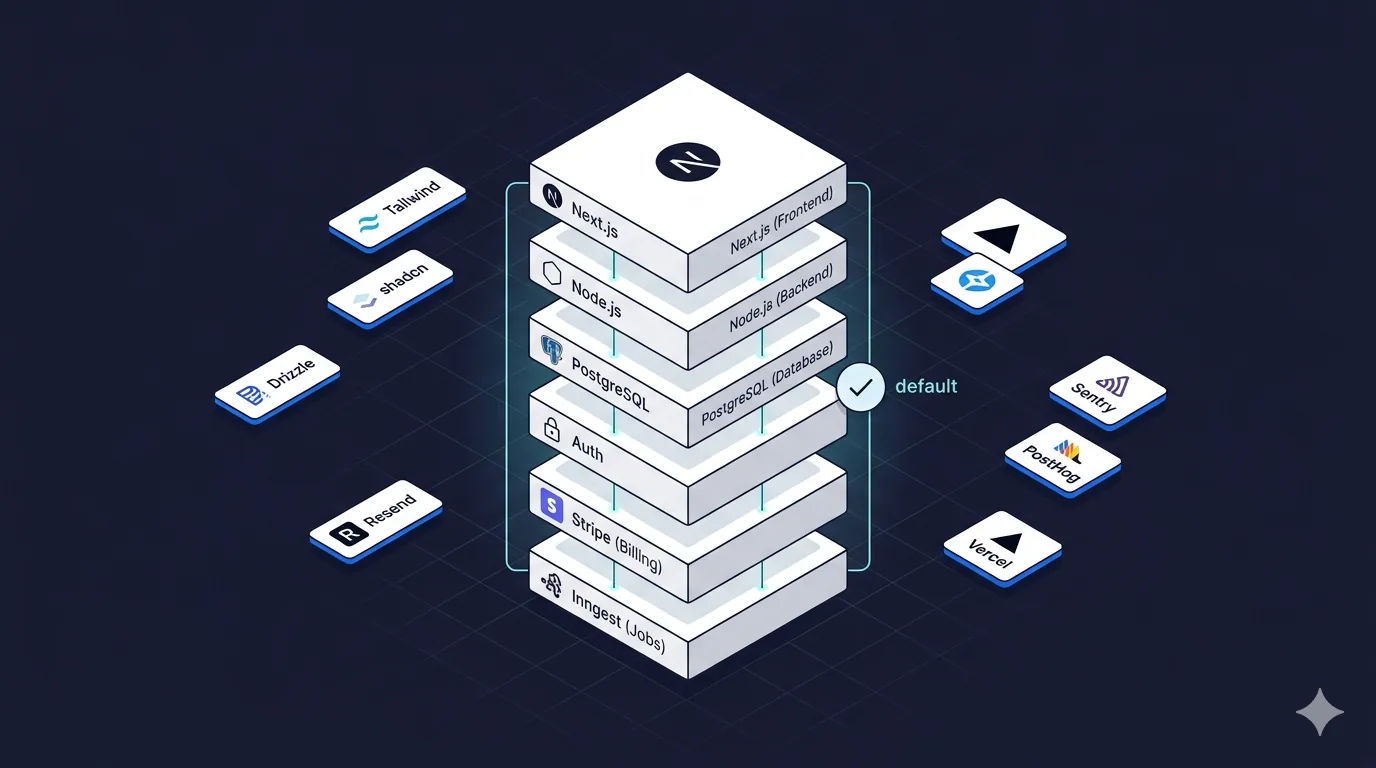
This is the opinionated answer to "what tech stack should I use for my SaaS MVP in 2026", with the actual library names and the cases where the default is wrong. Written for funded founders and technical co-founders who want to stop debating the stack and start shipping.
If you want the broader context on building a SaaS startup (scope, timeline, team), our SaaS web application development guide for startups is the parent pillar. If you are building an AI-first product, our AI MVP tech stack post goes deeper on the AI-specific variants. For who builds it, see hire full stack developers and hire Node.js developers.
What is the best tech stack for a SaaS MVP in 2026?
For 80 percent of SaaS MVPs, the right default is Next.js plus Node.js plus PostgreSQL plus managed auth plus Stripe, deployed on Vercel and Railway. Here is the full default stack with the specific libraries we ship every week.
| Layer | Default pick | Why this one |
|---|---|---|
| Frontend framework | Next.js 15 (App Router) | Server components, fast iteration, biggest hiring pool, SEO out of the box, edge runtime when you need it |
| UI / styling | Tailwind CSS + shadcn/ui | shadcn gives you owned, copy-paste components built on Radix. No vendor lock-in, no design-system trap. |
| Backend | Node.js (Next.js API routes or Hono / Fastify) | One language across the stack. Pick Python FastAPI instead if you are AI-heavy. |
| Database | PostgreSQL on Supabase, Neon, or RDS | Relational, battle-tested, scales further than any startup ever needs |
| ORM | Drizzle (preferred) or Prisma | Drizzle is lighter and SQL-native. Prisma still wins on tooling polish. Either ships. |
| Auth | Clerk (SMB), WorkOS (B2B SSO), Supabase Auth (if already on Supabase) | Never build auth yourself. The time saved is enormous and the security risk avoided is real. |
| Billing | Stripe Billing | Subscriptions, proration, tax, dunning. Building this is a trap that has killed many MVPs. |
| Background jobs | Inngest (preferred) or BullMQ with Upstash Redis | Inngest is event-driven and handles retries, throttling, and visibility cleanly. BullMQ if you want full control. |
| Email (transactional) | Resend or AWS SES | Resend has the best developer experience. SES is cheaper at scale. |
| Observability | Sentry (errors) + PostHog (product analytics) | PostHog also handles feature flags + session replay in one tool |
| Frontend hosting | Vercel | Tightest Next.js integration. Switch to AWS later when cost demands. |
| Backend / DB hosting | Railway, Render, or Fly.io | Zero-ops to start. Migrate to AWS or GCP when you have a real ops need. |
This stack ships SaaS MVPs in 8 to 16 weeks at typical scope. It is what we default to for client work and what we recommend founders pick when they ask, every single time, unless one of the exceptions below applies.
Why Next.js + Node.js is the default in 2026 (and not the other contenders)
The honest reasons Next.js plus Node.js wins as the default, ranked by what actually matters at the MVP stage.
1. Hiring pool. JavaScript and TypeScript are the largest engineering pool in the world. You can hire a Next.js developer in any city, in any timezone, at any seniority level, today. Try hiring a senior Remix developer in week one and you will see the difference.
2. Documentation and AI assistance. Next.js, Node.js, PostgreSQL, and the surrounding libraries are the most-trained-on stack in every major code LLM. Cursor, Claude Code, and Copilot all generate working code for this stack at near-zero friction. Exotic stacks force the model into hallucinations.
3. Same language frontend and backend. One language means one mental model, one set of types, one toolchain. At MVP scale (1 to 4 engineers), that simplicity is worth more than the theoretical performance gains of splitting Python or Go backend from a JavaScript frontend.
4. Vendor maturity. Vercel, Supabase, Neon, Clerk, Stripe, Inngest, Resend, PostHog, Sentry. Every layer has a serious managed vendor with a free tier you can use to ship the MVP and clean upgrade paths when you grow. The Python and Rails equivalents exist but the polish is uneven.
5. SEO and SSR out of the box. Next.js handles server-side rendering, static generation, edge runtime, and metadata APIs natively. For any SaaS with a marketing site or content-driven acquisition motion, this is a real advantage over a SPA stack.
Things people will argue about that do not actually matter at MVP stage: Bun vs Node performance, React Server Components vs traditional SSR, edge vs Node runtime for API routes, CSS-in-JS vs Tailwind. Pick the default, ship the product, optimize later.
When should you pick Python FastAPI instead of Node.js for the backend?
Pick FastAPI when your product is fundamentally an AI product, meaning the core value proposition is "an LLM does something useful and the UI is just the wrapper." Examples: an AI agent for some business workflow, a RAG-based research tool, a model-evaluation product, a fine-tuning platform, a vector search product.
Why FastAPI in those cases: the AI ecosystem (LangChain, LlamaIndex, Hugging Face, every model SDK, every vector DB client, every observability tool like Langfuse and Helicone) is Python-first. Building those things in Node works but you are constantly the last to get new features and you write more glue code than you should.
For everything else (B2B SaaS, internal tooling, marketplaces, scheduling apps, fintech, edtech, vertical SaaS) Node.js is the better backend because the same engineers can move between frontend and backend without context switching.
Our AI MVP tech stack post covers the Python-heavy variant in detail.
When should you pick Rails, Django, or Laravel instead?
Pick a batteries-included monolith framework when you are a solo technical founder building the whole MVP yourself and you already know one of these frameworks well. The reason is simple: Rails or Django give you authentication, admin panels, background jobs, and database migrations as one coherent package out of the box. For a solo founder, that coherence saves real time over the JavaScript stack's mix-and-match approach.
Specifically:
- Rails if you used to be a Rails developer. The 2026 version (Rails 8 with Solid Queue, Solid Cache, and Hotwire) is genuinely productive for solo founders shipping a v1.
- Django if your product needs a heavy admin panel (Django admin is still unbeaten) or your team is Python-leaning.
- Laravel if your team is PHP-strong and you are building a SaaS for an audience that does not care about the underlying tech.
Pick Rails, Django, or Laravel NOT just because you read a blog post claiming they ship faster. If your hiring pool is JavaScript, you will end up rebuilding on Next.js plus Node within 18 months. If your team is already Ruby or Python or PHP, the monolith path is genuinely fine.
What about Remix, SvelteKit, Astro, Nuxt, or other meta-frameworks?
Pick one of these only if you already know it cold and the rest of your team does too. They are all good frameworks. None of them have a hiring pool deep enough or a vendor ecosystem mature enough to justify picking them over Next.js for a generic SaaS MVP.
- Remix / React Router 7: Cleaner data loading and forms model than Next.js. Smaller community, smaller vendor ecosystem. Pick if your team prefers the model and you are okay with the smaller ecosystem.
- SvelteKit: Best developer experience in this category. Hiring is genuinely harder; the React community is 10x bigger.
- Astro: Great for content-heavy sites and marketing pages. Not the right primary framework for a dynamic SaaS application.
- Nuxt (Vue): Fine framework. Vue's hiring pool is smaller than React's in the US and Europe; bigger in some other markets.
- Solid Start, Qwik, fresh framework of the month: Do not pick these for a production MVP unless you have a specific technical reason and a willingness to ship infrastructure yourself.
The pattern: meta-framework choice is a taste decision. If the team has strong taste and conviction, go for it. If you are debating, default to Next.js and move on.
What about microservices, GraphQL, gRPC, or service-oriented architecture?
Do not build microservices for an MVP. Period. Build a monolith. The number of MVPs we have seen die because the founders decided to "architect for scale from day one" with 8 services and a Kafka topic is heartbreaking.
Specifically:
- Monolith first. One Next.js app with API routes for everything. Split into services only when one of them is causing a real, measured bottleneck.
- REST or RPC, not GraphQL, unless you have a specific reason. GraphQL is great for client-driven product surfaces (think Shopify's storefront API) and overkill for the typical SaaS where one frontend talks to one backend. tRPC is a sensible alternative if you want end-to-end type safety.
- No gRPC, no Kafka, no message bus. Until you have a real ops team. Inngest plus PostgreSQL handles every async workflow an MVP needs.
- One PostgreSQL database with a tenant_id column. Schema-per-tenant or database-per-tenant is for after your first enterprise customer pays for it.
The discipline here saves more time than every framework optimization combined.
Which auth provider should you actually pick?
Auth is the most over-debated decision in the SaaS stack. The honest answers:
- Clerk: Best developer experience for B2C and prosumer SaaS. Hosted UI components, magic links, OAuth, MFA, sessions, all done. USD 25 to USD 100 per month at startup scale.
- WorkOS: The right pick the moment you are selling to mid-market or enterprise B2B and need SSO (SAML, Okta, Azure AD). Free up to 1 million MAUs for the base product; SSO add-on starts free for the first connection.
- Supabase Auth: Pick if you are already on Supabase for the database. It is tightly integrated and good enough. The dev experience is less polished than Clerk.
- Auth0: Was the default for years. Now expensive and the developer experience has fallen behind Clerk and WorkOS. Pick only if your team already knows it.
- Roll your own: Never. Not for an MVP. Not for a v2. Not until you are 100+ engineers with a security team.
The rule: pick Clerk for B2C and SMB B2B. Switch to WorkOS when you land your first enterprise customer needing SSO. Both have clean migration paths.
Which database setup should you actually pick?
PostgreSQL. The only debate is which managed provider.
- Supabase: Postgres plus auth plus storage plus realtime in one package. Best for MVP speed when you want the all-in-one feel. Hosted in their cloud or self-hosted.
- Neon: Postgres-only, serverless, instant database branching for previews. Best when you want pure Postgres and good Vercel integration.
- RDS or Aurora: When you need full control or compliance requires AWS. Worth it later, not at MVP.
- PlanetScale: MySQL, not Postgres. Excellent product. Pick only if you have a strong reason to use MySQL.
- Turso (SQLite): Fast for edge use cases. Not the right primary DB for a generic SaaS MVP.
For most SaaS MVPs, Supabase or Neon. Pick Supabase if you also want their auth and storage. Pick Neon if you want pure Postgres and you already have Clerk for auth.
What background job system should you pick?
This is the layer founders skip until they need it, then panic-implement under pressure. Build it in week one of the MVP.
- Inngest: Event-driven, durable workflows, retries and throttling built in, beautiful dev tools. Free tier is generous. Our default pick for SaaS MVPs in 2026.
- BullMQ + Upstash Redis: DIY Node-native queue. More work to set up, more control. Pick if you want to own the queue infrastructure.
- Trigger.dev: Similar to Inngest, also good. Pick whichever fits your team's taste.
- Vercel Cron + database queues: Fine for very small workloads. Will hit limits fast.
- AWS SQS + Lambda: Fine if you are already on AWS. Overkill for most MVPs.
You will need async work for emails, exports, webhooks, AI calls, and scheduled jobs before you think you will. Pick Inngest, integrate it in week one, move on.
What about the AI layer if your product uses AI for one feature (not the core)?
Plenty of SaaS MVPs have one AI feature inside a non-AI product. For that, you do not need a Python backend. The right approach:
- Call the model SDK (Anthropic, OpenAI, etc.) directly from your Node backend
- Use Vercel AI SDK for streaming responses in the UI
- Use a managed vector DB (Pinecone, Turbopuffer) if you need retrieval; otherwise skip vectors entirely and use full-text search with Postgres
- Add Langfuse or Helicone for observability when you have more than 100 calls per day
The Python backend question only comes up when AI is the product itself, not when it is one feature inside a SaaS.
How do you actually pick the stack for your specific MVP?
Three questions, in order:
1. Is AI the core product? If yes, Python FastAPI backend plus Next.js frontend. If no, Node backend.
2. Are you a solo technical founder who already knows Rails, Django, or Laravel? If yes, ship in your framework, you will move faster. If no, default JavaScript stack.
3. Are you selling to enterprise B2B from day one with SSO required? If yes, build with WorkOS as the auth layer from week one. If no, Clerk.
That is it. Everything else is the default stack: Next.js, Tailwind, shadcn, Drizzle, PostgreSQL on Supabase or Neon, Clerk or WorkOS, Stripe, Inngest, Resend, Sentry, PostHog, Vercel, Railway.
What does this stack actually cost to run at MVP scale?
For a SaaS MVP with under 1,000 users, monthly costs land roughly here:
| Service | Free tier covers | Cost at MVP scale (USD/mo) |
|---|---|---|
| Vercel (Pro) | Hobby fine until launch | 20 |
| Supabase or Neon | Free until 1-2 GB DB | 25-50 |
| Clerk | 10k MAU free | 0-25 |
| Stripe | Pay per transaction | Variable |
| Inngest | Free up to 50k step runs | 0-20 |
| Resend | 3,000 emails/mo free | 0-20 |
| Sentry | 5k errors/mo free | 0-26 |
| PostHog | 1M events/mo free | 0 |
| Domain + email | - | 20 |
| Total at MVP scale | - | 65 to 181 |
You can launch on under USD 100 per month, including domain and email. The bill scales gradually as you get users, not in discontinuous jumps. This is one of the underrated wins of the default stack: every layer has a sensible free tier you can use to validate before paying.
What should you do this week?
Three steps.
Step 1. Answer the three questions in the picking section above. Write the answers down so you stop debating.
Step 2. Spin up the default stack as a working hello-world. A Next.js app with Clerk login, a Supabase database, one API route, Stripe checkout for a USD 1 test plan. End-to-end working in a day or two. This is your foundation.
Step 3. Build your one core workflow on top. Do not add Sentry, PostHog, Inngest, or background jobs until the core workflow works. Then add them, in week one of real product work, before you forget. Tell us your one-sentence core workflow and we will scope a realistic build with this stack in 48 hours, fixed price.
Boring stacks ship faster, hire easier, and break less. In 2026, the boring choice for a SaaS MVP is Next.js plus Node plus PostgreSQL plus the managed providers above. Pick it, ship the product, and let the customers tell you what to build next.