
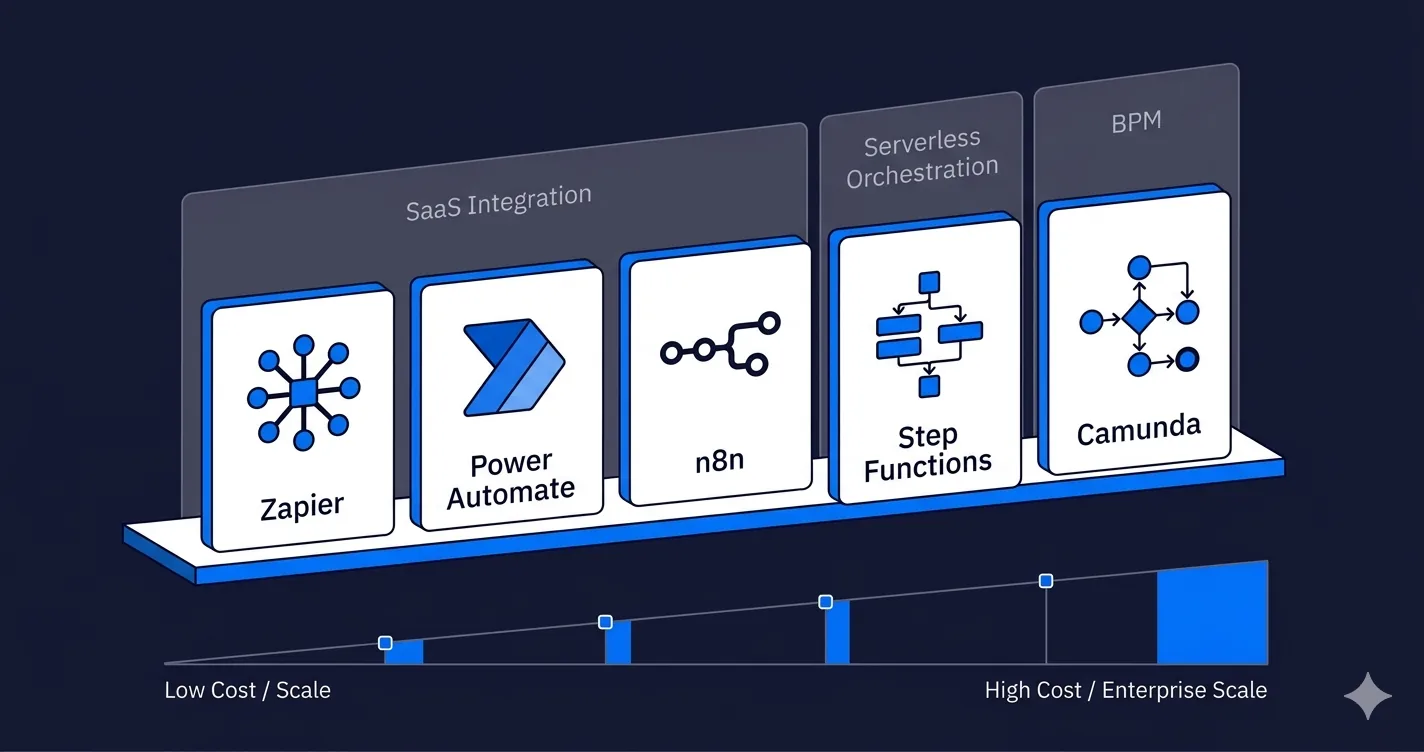
Five very different tools show up when someone asks "how do we automate this workflow." n8n, Microsoft Power Automate, AWS Step Functions, Camunda, and Zapier all claim to orchestrate work between systems. They do it at wildly different price points, scale ceilings, and technical commitments. Pick the wrong one and you either overpay by 10x or outgrow the tool in a year and migrate at great expense.
This post walks through what each tool is actually for, who should pick which, and how pricing and scale shape the decision in 2026. If you are evaluating workflow automation tools for your team, this is the short list to bring to the decision.
What do these five tools actually do?
All five move data and trigger actions between systems. The category split matters more than most people realize:
iPaaS / SaaS integration tools. Zapier, Power Automate, and n8n (in its cloud form) are what most people mean when they say "automation." They connect SaaS apps (Slack, Salesforce, Notion, Gmail, Shopify) without writing much code. Low floor, broad app support, mostly pay-per-task pricing.
Serverless orchestration. AWS Step Functions is a workflow engine for AWS-native code (Lambda, ECS, DynamoDB, Bedrock). It is not for connecting random SaaS apps, it is for stitching together your own services with retries, parallelism, and state.
BPM / workflow engines. Camunda is an enterprise workflow engine built on BPMN 2.0, the industry-standard notation for business workflows. It runs long-lived, stateful processes (loan approvals, claims, order fulfillment) that might span days or weeks with human approvers in the loop.
A single company often uses three of these for different problems. They do not really compete head-to-head, they compete for different budgets.
Which category does your problem actually fit?
Before comparing prices, figure out which class of problem you have:
- "I want to post Shopify orders to Slack" or "Add new Gmail contacts to HubSpot." This is SaaS integration. Zapier, Power Automate, or n8n.
- "I need to orchestrate five Lambda functions with retries and branching logic." This is serverless orchestration. Step Functions.
- "I need to run a 90-day loan approval process with audit trails, human approvers, escalation rules, and regulatory traceability." This is BPM. Camunda.
Most teams trying to force one tool across all three categories end up hating the tool. Zapier is miserable for serverless orchestration. Step Functions is miserable for Slack integrations. Camunda is overkill for either.
When should you pick Zapier?
Zapier is the default for non-technical users connecting SaaS apps. More than 6,000 app integrations, a UI a marketer or ops lead can use without a developer, and a zero-code trigger-action model that covers most simple workflows.
Pick Zapier when your team is mostly non-engineers, you are integrating known SaaS apps, and your workflow is simple (trigger, filter, action, done). Pricing scales quickly once you move past a few thousand tasks a month, which is Zapier's biggest weakness. Teams that start on Zapier and grow often migrate to n8n inside 12 months specifically because of cost.
When is Microsoft Power Automate the right call?
Power Automate is the natural pick if your company already lives in Microsoft 365. It wires into Outlook, Teams, SharePoint, Dynamics, and Azure with lower friction than anything else, and it bundles desktop RPA for automating legacy Windows apps. Licensing is often cheaper than Zapier for enterprise seats already on M365 E3 or E5.
Pick Power Automate when your workflows are mostly inside the Microsoft ecosystem and your users already have Microsoft licenses. The rest of the market is weaker (fewer quality third-party connectors than Zapier), and pricing can get complicated fast across per-user, per-flow, and process (RPA) plans. Enterprise ops teams love it, marketing and growth teams usually find it clunky compared to Zapier.
When does n8n win?
n8n is what you pick when you want automation without the per-task tax. Self-hosted n8n on a small VPS costs $5 to $40 a month of infra and gives you unlimited executions. The cloud version starts around €20 per month and is meaningfully cheaper at scale than Zapier.
More importantly, n8n ships a Code node that lets developers drop into JavaScript (or Python via community nodes). This is the killer feature for engineering teams that need 80 percent no-code with a 20 percent escape hatch. Zapier and Power Automate both have code steps, but they feel bolted-on.
Pick n8n when you have a developer who can self-host (or when you need the cost control of the cloud tier), you want to avoid SaaS lock-in, and you are willing to accept a slightly steeper learning curve than Zapier. Our backend engineers set up self-hosted n8n on Docker for clients in under a day and hand over a runbook.
When do you reach for AWS Step Functions?
Step Functions is not in the same category as the first three. It orchestrates your own code, not SaaS integrations. If your workflow looks like "call Lambda A, then based on its output call Lambda B or Lambda C, retry three times on failure, and write the result to DynamoDB," Step Functions is the right tool.
Two flavors matter. Standard Workflows handle long-running processes (up to a year) with full audit trails, priced at $0.025 per 1,000 state transitions. Express Workflows run high-volume short workflows at $1.00 per million requests plus compute time. Express is where most production throughput lives, Standard is where long-running business logic lives.
Common use cases: ETL pipelines, ML inference orchestration, microservice sagas, batch processing. Pick Step Functions when you are already on AWS, your workflow is orchestrating your own services, and you need native integration with IAM, CloudWatch, X-Ray, and VPC. Do not pick it for connecting SaaS apps. If you need someone who has shipped Step Functions in production for data or ML workloads, our data engineers have. See also our guide on choosing an AI agent framework if your orchestration is AI-heavy.
When does Camunda make sense?
Camunda is the tool you use when a lawyer or auditor might one day ask "show me every step of this process and who approved what." It runs BPMN 2.0 processes, the industry-standard notation for business workflows, and it is built for processes that are long-lived, stateful, and have human approvers in the loop.
Banks, insurance companies, healthcare systems, and telecoms run Camunda for loan approvals, claims processing, and order fulfillment workflows that can span weeks or months. The open source core (Zeebe) is free to self-host. Camunda Platform 8 SaaS or self-managed enterprise editions typically start in the low-to-mid five figures annually and scale from there based on process instance volume.
Pick Camunda when your workflow is long-running (days to months), must survive restarts without losing state, needs human approvers, and is subject to audit or compliance. If you are running at enterprise scale in a regulated industry, Camunda is almost always in the final shortlist. Do not pick it for "post to Slack when a form is submitted." You will cry.
How do the five compare on scale and pricing in 2026?
Rough numbers from recent pricing pages and client engagements. Pricing changes, verify before committing budget.
| Tool | Category | Pricing floor | At ~10k runs/month | At ~1M runs/month | Self-host? |
|---|---|---|---|---|---|
| Zapier | iPaaS | Free 100 tasks/mo; $19.99/mo Starter | $49/mo Professional | Custom Enterprise (often $1k+/mo) | No |
| Power Automate | iPaaS + RPA | $15/user/mo | Bundled with M365 E5 often enough | Enterprise licensing + process plan extras | No |
| n8n | iPaaS (open source) | Free self-hosted; €20/mo cloud Starter | €50/mo cloud Pro or ~$10/mo VPS | ~$50/mo VPS self-host or custom enterprise | Yes |
| AWS Step Functions | Serverless orchestration | Pay per use ($0.025 / 1k transitions) | <$5/mo (Standard) or <$1 (Express) | ~$250/mo (Standard) or ~$50 (Express) + Lambda cost | AWS-only |
| Camunda | BPM engine | Free (Zeebe open source) | Self-managed free; SaaS starts ~$20k/yr | Enterprise $50k to $200k+/yr | Yes |
Two patterns jump out. First, Zapier is cheap to start and expensive at scale, n8n is the opposite when self-hosted. Second, Step Functions and Camunda have free tiers but they are designed for enterprise budgets at real scale. Their cheap floors hide the engineering time required to use them properly, which is a real cost.
Which tool should you choose? A decision framework
Four questions get you 90 percent of the way to the right pick:
1. Are you connecting SaaS apps, orchestrating your own code, or running a long-lived business process? This eliminates three of the five tools immediately.
2. Is your team engineering-heavy or ops-heavy? Ops-heavy teams want Zapier or Power Automate. Engineering teams want n8n, Step Functions, or Camunda depending on the workflow type.
3. How many runs per month at 12-month projection? Under 2k runs, Zapier's cheap tier is fine. 10k to 100k, n8n wins on cost. Above that, Step Functions or self-hosted n8n wins. Camunda's pricing is per process instance and does not really compete on cost, it wins on compliance and auditability.
4. Do you have compliance, audit, or regulatory requirements? If yes, Camunda for BPM or Step Functions with CloudWatch and CloudTrail. Zapier, Power Automate, and n8n are all weaker on deep audit logging out of the box.
Short version by team shape:
- Small team, non-technical, simple SaaS workflows: Zapier.
- Microsoft 365 shop: Power Automate.
- Engineering team that wants cost control and ownership: n8n (self-hosted).
- AWS-native, orchestrating your own services: Step Functions.
- Regulated industry with long-running processes: Camunda.
The shortest version
These are not five competitors, they are three categories. Pick the category first: SaaS integration (Zapier, Power Automate, n8n), serverless orchestration (Step Functions), or BPM engine (Camunda). Inside each category, price the tool against your expected 12-month run count before committing, because the cheap option at 1k runs a month is almost always the expensive option at 1M. If you want a second opinion on which fits your use case, or an engineer who can set up and run any of these, get in touch.