
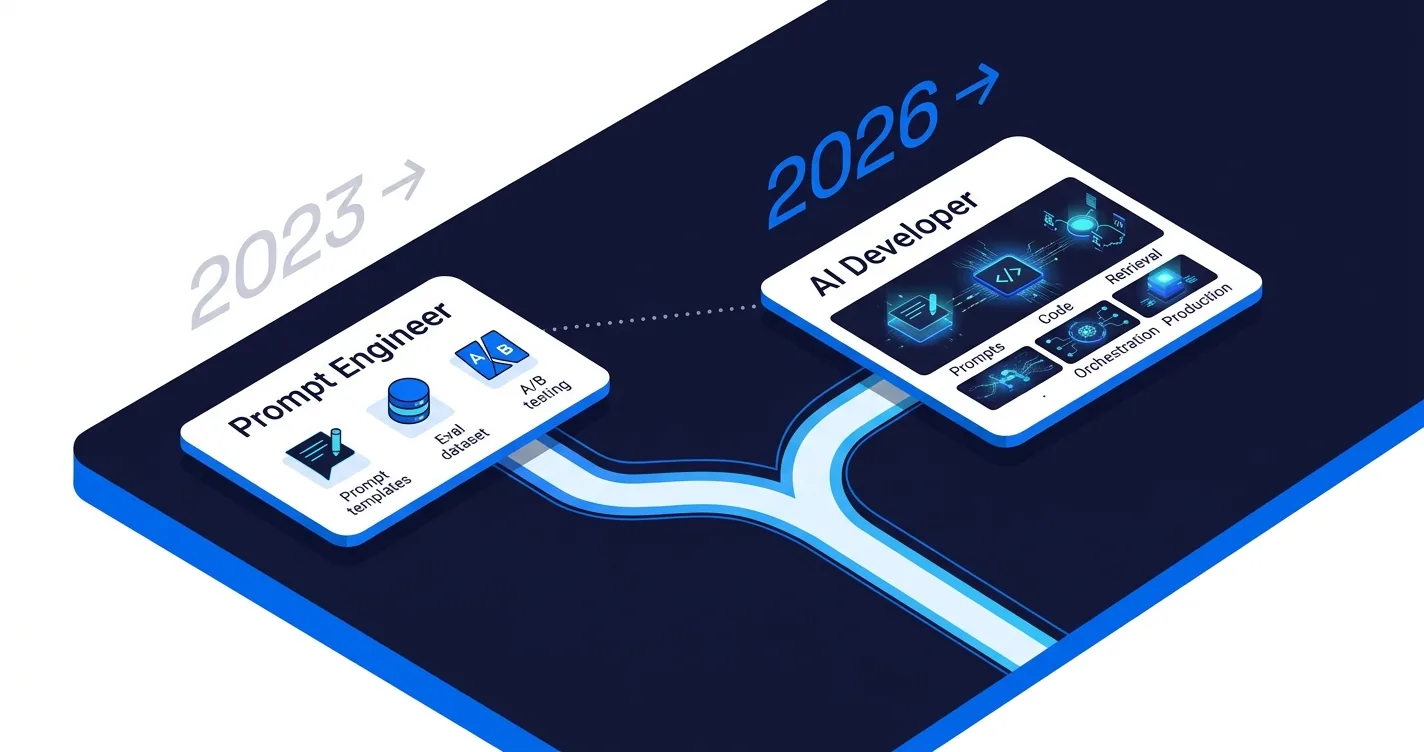
Pure prompt engineer roles are rare in 2026. Most teams now hire AI developers who prompt-engineer as part of the job, or they hire a domain expert who writes prompts and leaves the plumbing to engineers. Here is when a dedicated prompt engineer still makes sense, when you want a full AI developer instead, and how to tell which shape your team actually needs.
If you are staring at a job description wondering whether the "Prompt Engineer" post you wrote will get serious applicants, or whether to rewrite it as "AI Developer," this post is for you.
What does a prompt engineer actually do in 2026?
The job title peaked in 2023, when GPT-3.5 was new, prompt tricks were the differentiator, and companies posted $300,000 roles for people who could coax reliable output out of a raw model. Most of that work is now tooling. Structured output, function calling, JSON schemas, and much better instruction-following in modern Claude, Gemini, and GPT-class models have absorbed the old "prompt hacking" tier.
What remains under the prompt engineer label is still real work, just narrower: designing system prompts and evaluation datasets for a specific domain, tuning prompts against a benchmark, and shipping prompt changes with proper versioning and A/B testing. It is closer to a content-and-evaluation hybrid role than a pure software engineering role.
Why did the standalone prompt engineer role shrink?
Three things compressed the role at roughly the same time:
Models got better at following instructions. A poorly worded prompt on GPT-3.5 could produce garbage. The same prompt on a current-generation model usually produces something sensible. The marginal value of squeezing the last 5 percent out of a prompt is smaller when the first 95 percent comes for free.
Tool calling and structured output went native. Function calling and JSON Schema output are first-class features in every major model API now. You no longer need a prompt wizard to get reliable JSON, you ask for it.
Teams realized prompt changes without evals are just vibes. The engineering-heavy half of the job (eval sets, A/B testing, production monitoring) swallowed the craft-heavy half. Companies hire AI developers who can do both, not prompt specialists who can only do one.
When is a dedicated prompt engineer still the right hire?
Three scenarios where the role still earns its seat:
High-stakes domain-specific prompts. Medical triage, legal reasoning, compliance-heavy customer interactions. The prompts are not just instructions, they are policy documents. A domain expert with prompt-engineering skill is worth their weight, especially if they own the eval dataset too.
High-volume production prompts where every token matters. A team running a million LLM calls a day saves real money by trimming each prompt by 200 tokens. A dedicated prompt engineer who lives in the eval dashboard and the token breakdown can pay for themselves. Usually pairs with infrastructure people, not replaces them.
Building a prompt library or internal tool used across many teams. Large companies with fifty LLM features across the product need a standards-setter. This role is often called "AI platform lead" or "LLM ops lead" rather than prompt engineer, but the shape of the work is the same.
When is an AI developer the better choice?
Almost every other scenario. If you are a small startup building a single LLM-powered product, an AI developer can do the full stack: prompts, evals, retrieval, orchestration, and production deployment. Hiring a prompt engineer separately creates handoff seams, and you end up paying two salaries for a job one senior person could do.
Hire an AI developer instead of a prompt engineer when:
- The work involves retrieval (RAG), agent orchestration, or tool use. These need code, not just prompt craft.
- You need someone to wire the LLM into a real app (API, frontend, database).
- You want a single owner for the LLM feature, not a handoff chain.
- You have not yet shipped an LLM feature to users. The first hire should be a builder.
See our post on AI developer interview questions for the screening framework we actually use when matching engineers.
How do you screen for real prompt-engineering skill?
Whether the title on the offer letter says "prompt engineer" or "AI developer," real prompt skill shows up in four signals:
They own an eval set. Ask: "Walk me through the last time you changed a production prompt. How did you know it was an improvement?" Strong candidates describe an eval dataset, a benchmark, and a regression suite. Weak ones say "it looked better."
They explain prompt decisions with tradeoffs. Ask them to walk through a prompt they are proud of. A real answer covers why they chose XML tags over markdown, why examples go before or after instructions, and why they structured output a certain way. A weak answer is "I just iterated until it worked."
They know when not to use prompting. Ask: "Here is a classification task with 10,000 labeled examples. Prompt engineering or fine-tuning?" A strong candidate talks about cost, latency, and when a small fine-tuned model wins on both. See our RAG vs fine-tuning guide for the full decision tree.
They have operated a prompt in production. Production prompts break. Inputs drift, users adversarially probe, model providers ship silent behavior changes. A candidate who has lived through a prompt regression and diagnosed it has instincts you cannot test with a take-home.
What should a prompt engineer actually cost?
The salary range for prompt-engineer-labeled roles is much narrower in 2026 than it was in 2023. Rough ranges we see on posted roles and client comps:
| Role shape | Typical US range | Offshore (India) range | What you actually get |
|---|---|---|---|
| Prompt engineer (standalone, non-coding) | $90k to $140k | $2,000 to $4,000/mo | Prompt craft, evals, domain content |
| AI developer (prompts + code + infra) | $140k to $220k | $4,500 to $9,000/mo | Full LLM feature ownership |
| LLM platform lead (prompts + infra + standards) | $180k to $280k | $7,000 to $12,000/mo | Platform-wide prompt standards, tooling, cross-team support |
The 2023 headlines of $300k prompt-engineer offers were outliers, and most of those roles quietly rescoped into AI developer work within a year. Plan compensation for what the person will actually do, not the job-title inflation from two years ago.
What is the right team shape for serious LLM work?
For most teams in 2026, the right shape is one or two AI developers who own the LLM feature end-to-end, with prompt-engineering skill built in. Add a domain expert part-time for prompt and eval input when the domain is specialized. Add a dedicated prompt engineer or LLM platform lead only when you have crossed a certain scale, meaning more than three LLM features in production, or more than a million calls a day.
What does not work: hiring a prompt engineer as your first AI hire at a startup with no AI feature in production. You end up paying someone to tune prompts for a product that does not exist yet. The first hire should build the product. The second or third hire, if your domain demands it, can specialize.
The shortest version
The standalone prompt engineer role is real but narrow. Hire one when your domain is high-stakes, your volume is huge, or you are setting prompt standards across a big company. For everything else, hire an AI developer who prompt-engineers as part of the job. Title inflation from 2023 does not match what the work actually looks like now, so write the job description based on the work you need done, not the title you read on LinkedIn. If you are figuring out your first AI hire and want a second opinion, reach out and we will help you scope it.