
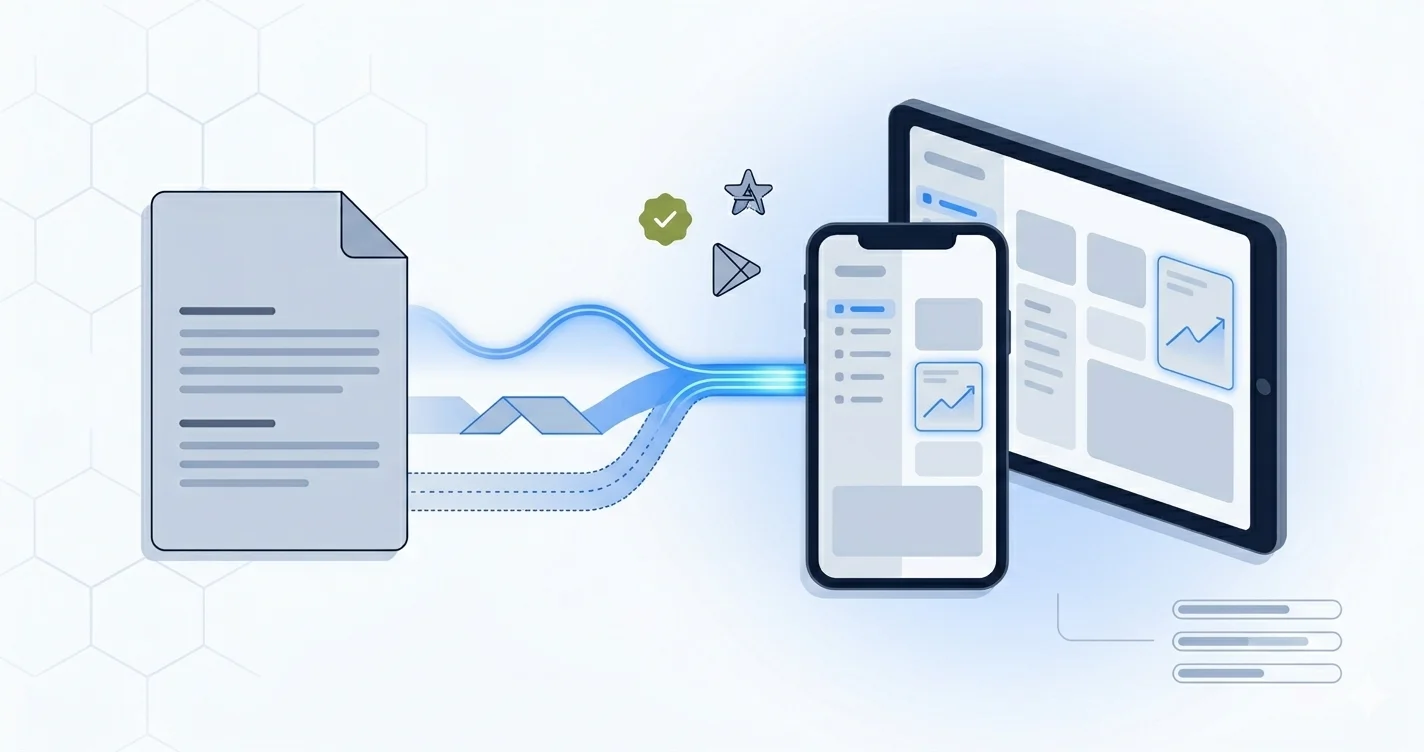
Cross-platform mobile developers from India give you full iOS and Android coverage from a single team, at roughly 60 to 70% lower cost than equivalent US hires. A senior cross-platform engineer from India runs USD 5,000 to 8,500 per month all-in, while a US senior fully loaded costs USD 14,000 to 19,000 per month.
Cross-platform mobile development is the practice of writing one codebase that ships to both iOS and Android stores, instead of maintaining two separate native apps. The three production-ready frameworks in 2026 are React Native, Flutter, and Kotlin Multiplatform.
If you already have iOS-only or Android-only pillar pages picked, see our iOS developer hiring guide and the Android hiring guide for 2026. This post is the cross-platform companion: when one team and one codebase makes more sense than two.
When should you hire cross-platform mobile developers?
Cross-platform is the right choice when at least three of these are true:
- Your app is mostly forms, lists, navigation, and API calls (typical B2B SaaS, marketplace, or fintech)
- You need iOS and Android at the same time, not one then the other
- You have a small team (under 8 mobile engineers) and cannot staff two native pods
- You ship feature parity across both platforms; platform-specific UX is rare
- Your performance budget is normal app responsiveness, not 60fps gaming or AR
Native (Swift for iOS, Kotlin for Android) wins when you need deep platform integration: ARKit / ARCore, advanced Bluetooth, video editing, real-time audio processing, or apps that must feel indistinguishable from Apple and Google first-party software. For everything else in 2026, cross-platform ships faster, costs less, and is hired more easily.
Which cross-platform framework should you hire for?
The framework choice is the highest-leverage decision before hiring. Each has a different talent pool, different ramp-up cost, and different production tradeoffs.
| Framework | Best for | India talent depth | Senior monthly cost (India) |
|---|---|---|---|
| React Native | Teams already on React / TypeScript on the web | Deep, largest pool | USD 5,500 to 8,000 |
| Flutter | Design-heavy consumer apps, custom UI, animations | Strong, growing fast | USD 5,000 to 7,500 |
| Kotlin Multiplatform | Existing native Android team adding iOS | Narrow, very senior only | USD 7,000 to 9,500 |
| Native iOS + Android (separate) | Performance-critical or platform-specific apps | Deep on both sides | USD 5,500 to 8,500 each |
React Native
React Native is the safest default for most teams. It uses React and JavaScript or TypeScript, integrates with the broader React ecosystem (React Query, Zustand, Tailwind via NativeWind), and has the largest senior talent pool in India. The new architecture (Fabric renderer, TurboModules) closes most historical performance gaps.
Hire React Native developers when your web team is already on React. The hiring market overlap is significant; many of the senior React frontend engineers we place can move into mobile work with one to two months of ramp-up.
Flutter
Flutter uses Dart and renders its own widgets to the screen, giving pixel-perfect consistency across iOS and Android. It dominates design-led consumer apps where the brand experience is the product. Animation, gesture handling, and custom layouts are often easier in Flutter than in React Native.
The trade-off is Dart, which is a smaller language community than JavaScript. Hire Flutter developers when your iOS and Android UI must look identical, or when your designers ship Figma comps with custom motion that React Native would struggle to match.
Kotlin Multiplatform (KMP)
Kotlin Multiplatform shares business logic across platforms but uses native UI on each side (SwiftUI on iOS, Jetpack Compose on Android). This gives you the best native fidelity but requires senior native engineers on both platforms, plus shared-module discipline. KMP is rarely the right starting choice; it is the right migration choice for a mature native Android team adding iOS.
What does it cost to hire mobile app developers from India in 2026?
Use these all-in monthly rates as a 2026 benchmark for India-based talent. All-in includes salary, benefits, equipment, and the partner team management overhead. For a deeper breakdown across engagement models, see dedicated developer vs freelancer vs agency total cost.
| Level | India (all-in / month) | US fully loaded (per year) | Years experience |
|---|---|---|---|
| Junior | USD 2,500 to 3,800 | USD 110,000 to 140,000 | 1 to 3 |
| Mid | USD 4,000 to 5,800 | USD 160,000 to 210,000 | 3 to 5 |
| Senior | USD 5,500 to 8,500 | USD 220,000 to 290,000 | 5 to 8 |
| Staff / Lead | USD 8,000 to 11,000 | USD 300,000 to 380,000 | 8 plus |
One thing not included in these numbers: the cost of a stalled release. A senior who has shipped to the App Store and Play Store ten times pays for themselves on the first release that does not get rejected. We screen specifically for App Store Connect and Play Console fluency.
How do you screen mobile developers from India?
The same four-stage loop we use for backend and frontend hires applies, with mobile-specific signals layered on top.
Stage 1: install their app and audit (45 minutes)
Ask for a real app live on the App Store or Play Store. Install it on your own device. Test cold start time, memory pressure, offline behaviour, and how it handles rotation, dark mode, and large dynamic type. You will learn more in 15 minutes of using their app than in an hour of resume review.
Stage 2: technical interview (60 minutes)
Pair on a small task in their preferred framework. Strong questions:
- Walk through how the JavaScript bridge works in React Native, and what TurboModules change about it
- Describe how Flutter renders without native widgets and the trade-offs that creates for accessibility
- Show me how you handle a deep link that opens a specific screen with parameters across both iOS and Android
- How would you debug a memory leak that only shows up on older Android devices?
Stage 3: paid trial (1 to 2 weeks)
This is the highest-signal step. Pay them a real rate to ship one feature in your codebase, including App Store screenshots, signing, and a TestFlight or Play Internal Testing release. Mobile has more shipping infrastructure than web, and senior developers should handle all of it without hand-holding. Use our verification checklist for what to watch.
Stage 4: reference and ownership signal
Two reference calls. Ask specifically about App Store rejections, production crash incidents, and how the candidate handled a release where the build was bad. Mobile rewards ownership in a way that web tolerates more loosely.
Where do cross-platform Indian developers fall short?
Honest assessment of where a senior US or European hire will out-perform on day one:
- Apple and Google design intuition. Senior native iOS and Android developers in San Francisco often have a deeper feel for what feels right on Apple's HIG or Google's Material 3 guidelines. India ships world-class B2B and fintech apps, but consumer-design instinct lags slightly.
- Edge platform features at launch day. ARKit, Vision Pro support, Dynamic Island integration, the latest Android system features, those tend to land in US-based mobile teams first. India catches up within 3 to 6 months.
- App Store legal and policy nuance. Reviewers reject for reasons that are hard to predict. Senior US-based developers often have more direct lines into App Store policy specialists. We compensate with a strict pre-submission checklist instead.
For most cross-platform B2B, marketplace, healthcare, and fintech apps, none of these gaps are deal-breakers. We deliberately make this comparison when we publish our global outsourcing benchmark.
What does a mobile pod look like at Workforce Next?
The right shape for most growing companies is a small dedicated pod: two to three senior cross-platform engineers, paired with a fractional engineering manager who owns release cadence, code review, and App Store submission discipline. SethAI matches engineers to your stack (React Native vs Flutter vs KMP), your CI tools (Bitrise, Codemagic, Fastlane), and your deployment cadence.
If you also need a mobile-specific testing team, that is a separate pod and we now staff it as a companion product. See our QA engineers page.
For the managed offshore team operating model end-to-end, see our india-handled overview.
Frequently asked questions
See the FAQ block below for quick answers on framework choice, native vs cross-platform, App Store risk, and engagement structure.
Ready to start? Book a 30-minute scoping call on our contact page and we will share three matched senior cross-platform mobile profiles within 5 business days, no fee until you hire.