
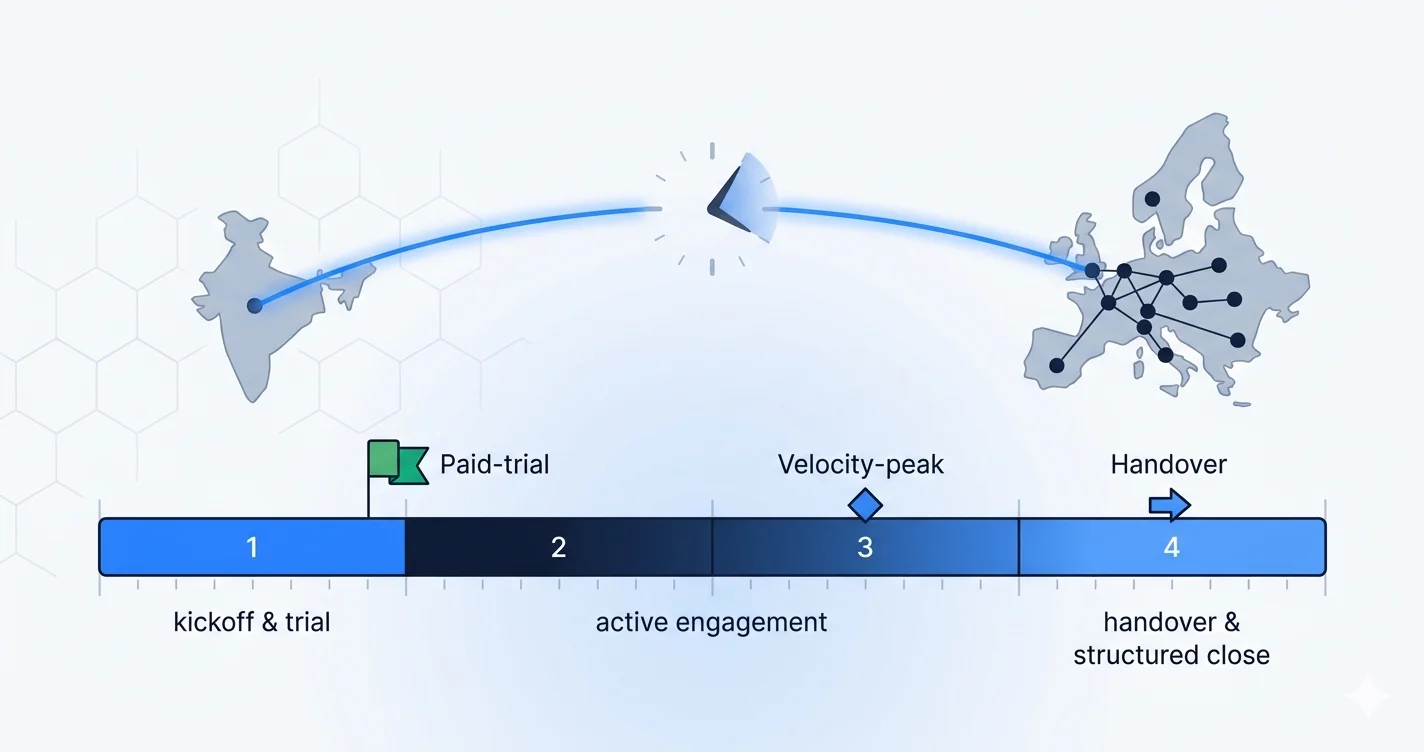
The offshore conversation in Europe usually pits Eastern Europe against LATAM, with India treated as a long-term-only option. The 2026 reality is more nuanced. India offers genuinely good CET and GMT timezone overlap, the strongest cost gap of the three regions, and a meaningful share of European engagements happens at the 3 to 4 month range specifically. This post is the honest buyer guide for that intersection: short-term Indian developer engagements for European projects.
Read alongside our For European Companies page for the production-shape pricing, GDPR framing, and timezone overlap table.
Why is the short-term India to Europe engagement underrated?
Three reasons most buyer research misses it:
- India vendor pages target the US first. The default vendor pitch is built for US buyers and emphasizes 24/7 Follow-the-Sun coverage, which is the wrong angle for European customers who already have natural timezone overlap.
- Most vendors push 6 to 18 month dedicated contracts. Short-term engagements get framed as a favor or as second-tier service. They are not, but the messaging is rare enough that European buyers assume they are not on the table.
- The cost math is buried under generic claims. A senior London developer costs roughly GBP 110,000 to 150,000 fully loaded; the Indian equivalent on a 3 month engagement runs the equivalent of GBP 16,500 to 24,000 for the entire 3 months. The arithmetic is striking but rarely shown directly to European audiences.
The result is a category gap. Buyers who type "3 month contract Indian developer" or "short term offshore developer Europe" into Google find scattered freelance marketplace results and generic content rather than a clean offer. This post is part of the answer.
How much CET and GMT overlap do you actually get with India?
The practical sync windows for European cities, with the standard caveat that India does not observe Daylight Saving so the offset shifts by an hour when European clocks change:
- London and Dublin (GMT/BST): 4 to 5 hours of daily overlap. India 1 PM to 6 PM IST is your 8:30 AM to 1:30 PM GMT or 9:30 AM to 2:30 PM BST.
- Berlin, Amsterdam, Paris (CET/CEST): Same shape, shifted by an hour.
- Stockholm, Oslo, Copenhagen: Same as Berlin.
- Helsinki (EET/EEST): 5 to 6 hours of overlap. The best India to Europe overlap on the list.
- Lisbon (WET/WEST): Same as London.
That is enough for a daily standup, real-time pair programming, and a sync review every working day without anyone shifting hours. For customers who want full-day overlap, we run shifted-schedule engineers who start later in the IST day to cover the full European afternoon. Shifted schedules are offered at no extra cost on engagements three months and longer.
How does India compare to LATAM and Eastern Europe for European projects?
The honest 2026 comparison, by axis that actually matters to European buyers:
- Timezone fit. Eastern Europe (Poland, Romania, Bulgaria) has the strongest natural fit for Western Europe at 0 to 2 hours offset. India sits at 4.5 hours. LATAM sits at 4 to 6 hours behind, which is the worst of the three for European customers (their morning is your evening). India edges LATAM for European overlap by a meaningful margin.
- Cost. India is the lowest of the three at roughly EUR 78,000 to 114,000 annualized for a senior on a long-term engagement. Eastern Europe runs EUR 95,000 to 130,000. LATAM runs EUR 90,000 to 130,000 for European customers (LATAM is priced for the US market, so European buyers pay roughly the same dollar rate but in EUR).
- Talent depth in AI and data. India has the largest available pool globally outside the FAANG-funded US enclave. Eastern Europe is strong in fintech and complex backend; the AI bench is smaller. LATAM is mid on both.
- Short-term engagement willingness. India and LATAM are both comfortable with 3 to 4 month engagements. Eastern Europe vendors increasingly insist on 6 to 12 month minimums, especially for senior engineers.
- Cultural and language alignment. All three regions have strong English fluency. Eastern Europe has the strongest cultural alignment with Western Europe by default. India and LATAM run a close second; both work well with deliberate onboarding effort.
For most European buyers running short-term work, the honest call: India for AI, data, scale, and lowest unit cost; Eastern Europe for fintech, regulated systems, and short timezone fit; LATAM for US-Pacific-aligned teams that happen to also have a European arm. The full 2026 outsourcing trends post covers the regional shape from the US side; this post is the European complement.
What does a 3 to 4 month engagement actually look like, week by week?
Short-term offshore engagements have a reputation for going wrong because the ramp eats the contract. A 3 month contract with a 4 week ramp leaves only 8 productive weeks. The ramp gets compressed deliberately so the math works:
- Week 0: matching call, candidate shortlist within 48 hours, customer interviews complete by end of week.
- Week 1: paid trial week. Real work on the actual codebase. Either side can walk if it is not the right fit.
- Weeks 2 to 4: ramp into ownership. Codebase walkthrough, architectural context, first shipped tickets.
- Weeks 5 through end: full velocity. Daily standup, sync review, paired programming during overlap windows.
- Final 2 weeks: structured handover. Documentation written, runbooks left behind, IP fully transferred.
On a 3 month engagement, that gives roughly 8 productive weeks of velocity. On a 4 month engagement, it gives 12 weeks. Most teams that run a 3 month engagement extend by month 3 because the timezone overlap and unit economics make the case for continuation.
Where do short-term engagements pay off the most?
Concrete fits we have shipped for European customers in the last year:
- Fixed-scope MVP sprints. A founder with a defined product idea wants to validate it in 8 to 10 weeks of build before a fundraise. One senior Indian developer plus a fractional product manager covers the work cleanly.
- Capacity surges. A funded startup hits a launch window or a board demo and the in-house team is at capacity. A 3 month surge fills the gap without permanent hiring overhead.
- Migrations. A framework upgrade, a cloud migration, a monorepo split. The work is bounded, the deliverable is clear, and a senior engineer who has done the migration before can ship it in the 3 to 4 month window.
- Interim cover. An in-house engineer is on parental leave for 4 months. A matching short-term engagement covers their stack and project, hands over cleanly, and ends when they return.
- Discovery and prototyping. A feature you are not yet ready to scope fully. An engineer prototypes in 8 to 12 weeks and the team makes the build-or-shelve call with real signal.
- Audit-and-remediate. Performance, security, or cost issues that need a focused engagement to fix without distracting the in-house team.
Where short-term engagements do not pay off: open-ended product hires with no defined end. If the work has no scope and no deadline, a long-term dedicated engagement amortizes ramp better and lets context compound. The India-handled page covers the long-term model.
How does the contract shape work without an EU entity?
One B2B services contract with Workforce Next Pvt. Ltd. EUR or GBP invoicing per customer preference. The engineer is our employee in India; you have no employment relationship with them. Indian payroll, PF, gratuity, equipment, and benefits stay our problem. There is no EOR, no entity setup, no payroll burden on your side. VAT is handled correctly per customer jurisdiction.
GDPR alignment is built into every European contract. Standard DPA terms compatible with Article 28, data minimization practices, audit logging, and access controls that meet the EU baseline. We can also operate under specific customer DPAs when the regulatory environment requires it.
IP transfer is unconditional. Work-for-hire assignment to the customer at the moment work product is created. At the end of a 3 or 4 month engagement, the IP transfer is already complete; nothing additional needs to be signed.
How much does a 3 or 4 month engagement actually cost?
All-in pricing for European customers, including our employer-side India overhead, equipment, payroll, and the engineering manager assigned to your account:
- Mid-level engineer. EUR 4,500 to 6,500 per month. 3 month total: EUR 13,500 to 19,500. 4 month total: EUR 18,000 to 26,000.
- Senior engineer. EUR 6,500 to 9,500 per month. 3 month total: EUR 19,500 to 28,500. 4 month total: EUR 26,000 to 38,000.
- Tech lead. EUR 9,500 to 13,500 per month. 3 month total: EUR 28,500 to 40,500. 4 month total: EUR 38,000 to 54,000.
The same monthly rate applies on a 3 month engagement and a 12 month engagement. There is no short-term premium. For comparison, a senior London developer fully loaded costs roughly GBP 9,000 to 12,500 per month (GBP 110,000 to 150,000 annualized including pension, employer NI, and benefits). The gap on a 3 month engagement runs roughly EUR 50,000 to 70,000 in the customer's favor.
What can go wrong, and how do we manage it?
The honest list of failure modes and how the contract structure handles them:
- Engineer underperforms in week 1. The trial week exists to catch this. Either side can walk with no further commitment.
- Engineer underperforms after the trial. Structured replacement within 7 to 10 business days at no extra cost. The contract end date is preserved.
- Project scope grows past 4 months. Frictionless extension at the same monthly rate. No extension fee, no re-matching, no recruitment fee.
- Project ends early. Contracts allow early termination with 30 days notice. No penalty.
- GDPR or data residency surprises mid-engagement. DPA is signed at the start of every engagement, so the framework is in place before issues arise. For customers with stricter data residency requirements (financial services, healthcare), we can route data flows through specific jurisdictions on request.
Final word
Short-term Indian developer engagements for European projects work better than the offshore conversation usually admits. The timezone math is favorable, the cost gap is wider than buyers expect, and the contract shape is built for the 3 to 4 month case rather than treating it as an exception. The reason this offer is uncommon is that India vendors target the US first, not because the model does not work.
If you are about to staff a fixed-scope European project from offshore, talk to us. We will match a senior engineer in 48 hours and start a paid trial week so you can see the shape of the engagement on your actual project before committing to the full 3 or 4 months.