
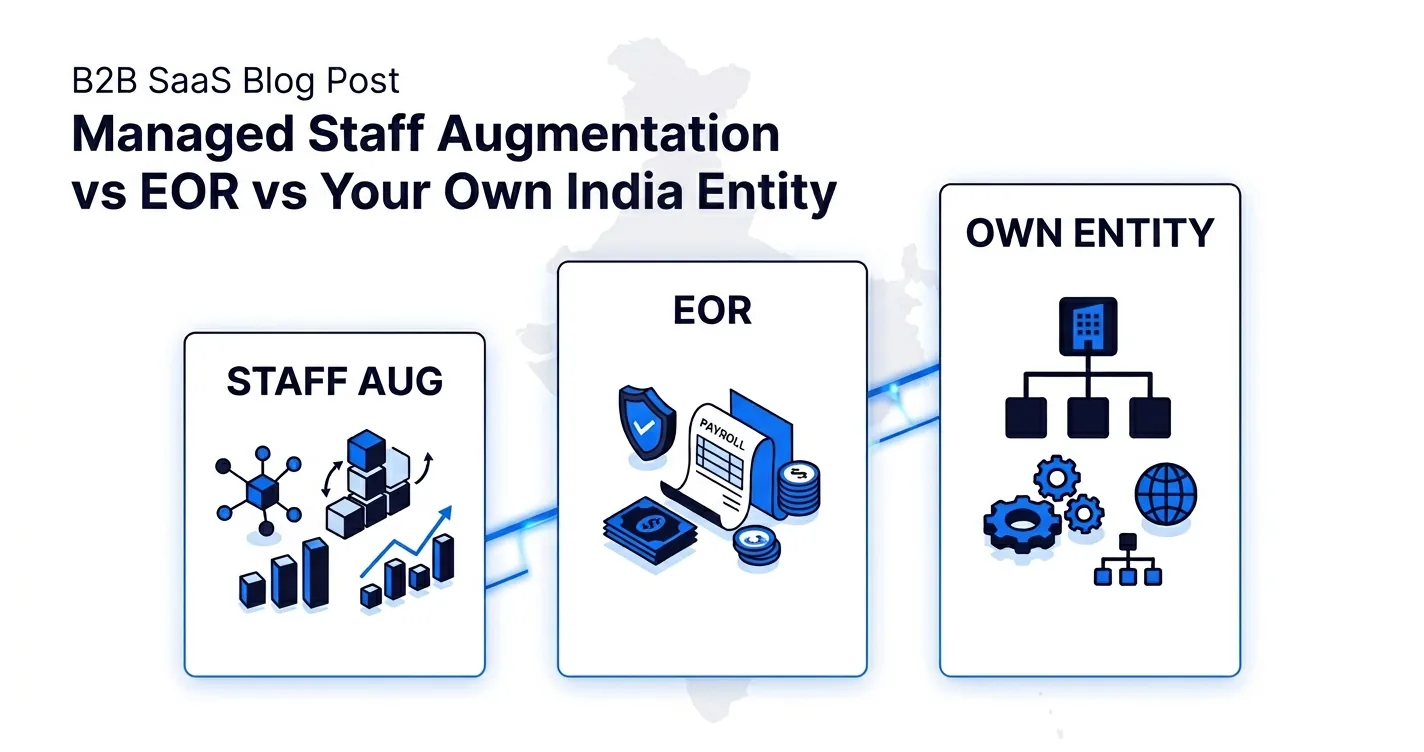
Three legitimate ways exist to hire engineers in India in 2026. Managed staff augmentation, an Employer of Record (EOR), or setting up your own India entity. Each one solves a different problem and each one is the wrong choice in the other two scenarios. This post lays out the differences side by side so you can pick the model that matches your stage and your risk tolerance, not the one your last vendor pitched.
If you are evaluating any of the three, this is the post to read first. It covers cost, setup time, IP ownership, compliance burden, FEMA exposure, and the realistic point at which each model starts to pay off.
What is the actual difference between staff aug, EOR, and your own India entity?
The three models look similar from a distance. They feel different the moment you sign a contract.
Managed staff augmentation. A vendor in India employs the engineer, dedicates them to your team, and bills you a B2B services invoice in your currency. The engineer is the vendor's full-time employee. You are the vendor's customer. There is no employment relationship between you and the engineer. We cover this model in detail on our India-handled page.
Employer of Record (EOR). An EOR is a legal-employment wrapper. You source and direct the engineer. The EOR holds the employment contract on your behalf, runs payroll, and handles statutory compliance in India. You have no Indian entity, but the employment relationship is structured as if you did. Deel, Remote, Multiplier, and Velocity Global are the well-known players.
Your own India entity. You set up a Private Limited subsidiary or a Liaison Office in India, hire engineers as your direct employees under Indian labour law, and run payroll, compliance, and HR in-house (or through a local CA). You own everything: the entity, the contracts, the IP chain, the cap table relationship, and every line of compliance.
The headline difference is who carries the operational and legal load. Staff aug puts almost all of it on the vendor. EOR splits it: you direct the work, the EOR handles the wrapper. An entity puts all of it on you.
Which model fits which company stage?
The right model is mostly a function of how many engineers you need in India and how long you intend to keep them there.
1 to 8 engineers, indefinite tenure: managed staff augmentation. The vendor's overhead is amortised across many clients, your unit cost is lowest, you skip every ounce of compliance work. Ideal for Series A through C SaaS, fintech, legaltech, and edtech teams that want a dedicated India pod without the entity headache.
1 to 5 engineers across multiple countries: EOR. If you are also hiring in Brazil, Poland, and the Philippines and want one consistent employment wrapper across all of them, EOR is the right call. The marginal cost per seat is higher than staff aug, but the consistency across geographies is the real product.
15 or more engineers, 3+ year horizon, India-specific roadmap: your own entity. At that scale, the fixed cost of running an entity (a Company Secretary, statutory audits, an HR head) gets amortised across enough headcount that the per-engineer overhead drops below what staff aug or EOR charges. You also get the option to acquire, IPO, or hire across India without renegotiating with a vendor.
Below 15 engineers but planning to grow there inside 12 months: staff aug now, with a pre-agreed transition path to your own entity later. Most of the staff aug vendors worth working with will help you transition the team to your entity when the math flips. (We do; ask us about it.) This avoids the trap of premature entity setup that drains $30K+ in setup costs before you know you actually need it.
How does the math compare across the three models?
Here is the side-by-side for a senior engineer (5+ years experience, modern stack) in 2026. Numbers are India-specific and based on what we see in actual contracts.
| Dimension | Managed staff aug | EOR | Your own India entity |
|---|---|---|---|
| Setup time before first engineer | 1 to 2 weeks | 2 to 4 weeks | 4 to 6 months |
| Setup cost | $0 | $0 to $500 (entity verification fees) | $15K to $40K (CA, legal, registrations) |
| Monthly cost per senior engineer (all-in) | $5,500 to $9,000 | $6,000 to $11,000 | $3,800 to $5,500 (after 12+ engineers amortise overhead) |
| Per-engineer cost includes | Salary, PF, gratuity, ESI, equipment, payroll ops, vendor margin, retention work | Gross salary plus EOR fee ($300 to $700/month) plus statutory employer cost | Salary, statutory contributions only. You add in-house overhead separately. |
| Ongoing fixed overhead | $0 (folded into monthly fee) | $0 (folded into monthly fee) | $30K to $80K/year (CA, audit, HR head, office) |
| Time to onboard a new engineer | 2 weeks (vendor handles) | 3 to 4 weeks (you source, EOR onboards) | 4 to 6 weeks (you source, you onboard) |
| Sourcing and screening | Vendor does it | You do it | You do it |
| Retention and replacement | Vendor's problem | Your problem (EOR is payroll only) | Your problem entirely |
The pattern: staff aug is cheapest below 15 engineers because you pay for talent and operations bundled. EOR is most expensive per seat because you pay for talent (which you sourced yourself) plus a payroll wrapper. Your own entity is cheapest above 15 to 20 engineers because the fixed overhead amortises across enough headcount.
For a granular breakdown of what each line item actually covers (PF, gratuity, GST, FEMA, equipment, IP), see our India-handled page which lists every operational category we cover under managed staff aug.
Who carries the IP, the compliance, and the FEMA risk in each model?
This is the section your General Counsel and CFO will care about most. The legal load splits very differently across the three models.
IP ownership. All three models can deliver clean IP transfer to your entity if the contracts are written correctly. Staff aug: the vendor's MSA carries an IP assignment from the vendor and from each engineer individually to your entity. EOR: the EOR's employment contract carries an IP assignment to you (because you are the deemed employer). Own entity: IP belongs to your Indian subsidiary by default; you transfer it intra-group through an inter-company agreement. The risk is with poorly drafted contracts, not with the model itself. Verify the chain in every case.
Indian labour law compliance. Staff aug: vendor carries 100% of it. EOR: EOR carries the compliance for the engineer's employment, you carry compliance for how you manage them (anti-discrimination, working hours, etc.). Own entity: you carry everything, and the surface area is non-trivial. Provident Fund (registered with the Employees' Provident Fund Organisation), ESI, gratuity, Shops & Establishments Act, Maternity Benefit Act, POSH Act, and statutory audits all sit on your books.
FEMA and RBI exposure. Staff aug: zero on your side. The vendor receives the foreign currency and converts. EOR: low, because you are paying the EOR's foreign entity. Own entity: real and ongoing. Every salary payment to your Indian subsidiary is a FEMA-regulated cross-border transaction governed by the Reserve Bank of India, and your Indian entity has filing obligations every year.
Permanent Establishment (PE) risk. This is the underrated one. If you direct a foreign worker too closely without the right legal wrapper, your foreign entity can be deemed to have a Permanent Establishment in India, which triggers Indian corporate tax on attributed profits. Staff aug: very low PE risk because the engineer is the vendor's employee, not yours. EOR: medium PE risk depending on how directly you manage the engineer. Own entity: zero PE risk because you have an actual entity. If you are pre-Series-B and worried about PE risk, staff aug is the safest place to start.
When is an EOR actually the right call?
EOR is the right model in three specific scenarios. We will route you to one if your situation matches.
You hire across many countries and want one wrapper. If your hiring footprint is India plus Brazil plus Poland plus the Philippines, an EOR like Deel or Remote that operates in all of them gives you contractual and operational consistency that no India-only staff aug vendor can match.
You already source talent yourself. If you have an internal recruiter who finds candidates and you only need the legal employment wrapper, paying a staff aug vendor for sourcing you do not need is wasteful. EOR is leaner for that case.
You want the engineer to be your direct (deemed) employee for cultural reasons. Some teams genuinely prefer the engineer to feel like a direct hire from day one, with your offer letter, your benefits, and your handbook. EOR delivers that. Staff aug technically delivers it too in practice, but if the legal frame matters to you, EOR matches your intent.
What EOR is not good at: replacing an underperforming engineer (you have to source the replacement yourself), running retention initiatives in India, or absorbing the swap cost when an engineer leaves. The EOR's job ends at payroll and compliance.
When is your own India entity actually the right call?
Three signals say it is time to set up your own entity.
You have 15 or more India-based engineers and clear plans for 25+ inside 24 months. At that scale the fixed overhead amortises and per-engineer cost drops below staff aug or EOR.
You have an India-specific product roadmap. If you are building for the Indian market, raising from Indian investors, or planning an India IPO, a local entity is a tax and regulatory necessity, not just an HR convenience.
You want to acquire Indian talent or companies. Acquihires, asset purchases, and IP acquisitions are dramatically cleaner when the acquiring entity is local. Without an entity, every acquisition involves a foreign-direct-investment filing.
What entity setup is not good at: getting started fast, staying flexible, or amortising overhead across small headcount. If you are below 15 engineers and not sure you will be above 25 in 24 months, you are paying entity overhead for a problem you do not yet have. We have seen Series A founders burn $30K to $50K on premature entity setup that becomes irrelevant when their India strategy shifts six months later.
When is managed staff augmentation the right call?
The largest slice of the market in 2026, and the model we run.
You want to start fast and stay flexible. First engineer onboarded in 2 weeks. No 12-month minimum. Month-to-month after that. If your India strategy needs to change at month 6, you change it without writing off entity overhead.
You want one vendor for talent and operations. Sourcing, screening, employment, payroll, compliance, equipment, retention, and replacement all sit with the vendor. You manage the work; the vendor manages everything around it.
You want the cheapest unit cost below 15 engineers. The math is in the table above. Staff aug is the lowest all-in cost in this range because the vendor's fixed overhead is spread across many clients, not just yours.
What staff aug is not good at: above 15 to 20 engineers it stops being the cheapest model. Vendor margin starts to matter more than overhead amortisation. The right play at that scale is a hybrid: keep the staff aug pod for some roles, transition the rest to your own entity. Our Not another body shop page explains how we run staff aug differently from the legacy TCS-Infosys-tier-2 pattern that earned the model its bad reputation in the first place.
What questions should you ask before picking a model?
Six questions to ask before any of these vendor calls. The answers determine which model fits.
- How many India-based engineers do you genuinely expect to have in 12 and 24 months?
- Is India your only offshore location or are you hiring in 3+ countries?
- Do you have internal recruiting capacity, or do you need sourcing handled?
- What is your General Counsel's tolerance for FEMA, PE, and statutory compliance exposure on your books?
- Are you planning to raise from Indian investors, acquire Indian companies, or sell to Indian customers in the next 36 months?
- How important is contractual flexibility (month-to-month) versus structural permanence to your team?
If your answers cluster around small headcount, fast start, no India-specific roadmap, and high contractual flexibility, you are a staff aug fit. If they cluster around multi-country hiring, internal sourcing, and consistent global wrapper, you are an EOR fit. If they cluster around large India headcount, India-specific roadmap, and willingness to absorb fixed overhead for amortised unit cost, you are an own-entity fit.
How do you actually transition from one model to another?
Most growing teams do not stay in one model forever. The realistic path looks like this.
Year 1, 1 to 8 engineers: managed staff aug. Lowest unit cost, fastest start, no entity overhead.
Year 2, 8 to 15 engineers: still staff aug, but start scoping the entity transition. Decide on entity type (Pvt Ltd vs Liaison Office vs LLP), pick a CA firm, draft the inter-company agreement template.
Year 3, 15+ engineers: open the entity in parallel. Move 5 to 10 anchor roles to the entity first (typically the longest-tenured or most senior). Keep newer hires on staff aug while the entity HR function ramps.
Year 4+: entity primary, staff aug for surge capacity or specialist roles where you do not want to add long-term headcount.
The vendors worth working with will help you do this transition cleanly, including transferring the engineer's tenure, statutory dues, and benefits to your entity. The ones who lock you in for 12 months and charge $50K to convert an engineer in-house will not. Worth asking about transition terms in the first call, not the last.
What to do next
If you have read this far, you have probably narrowed to one or two of the three models. The fastest way to validate is a 15-minute call where we walk through your specific stage, headcount, and roadmap, and tell you honestly which model fits best, even if it is not us. Book the call here and we will send you a one-pager with the comparison applied to your specific situation before the meeting.
Related reading worth your time: Dedicated developer vs freelancer vs agency: the real total cost of ownership covers the same comparison logic for engagement type rather than employment model. The real cost of switching tech partners is worth reading before you commit to any 12-month minimum.