
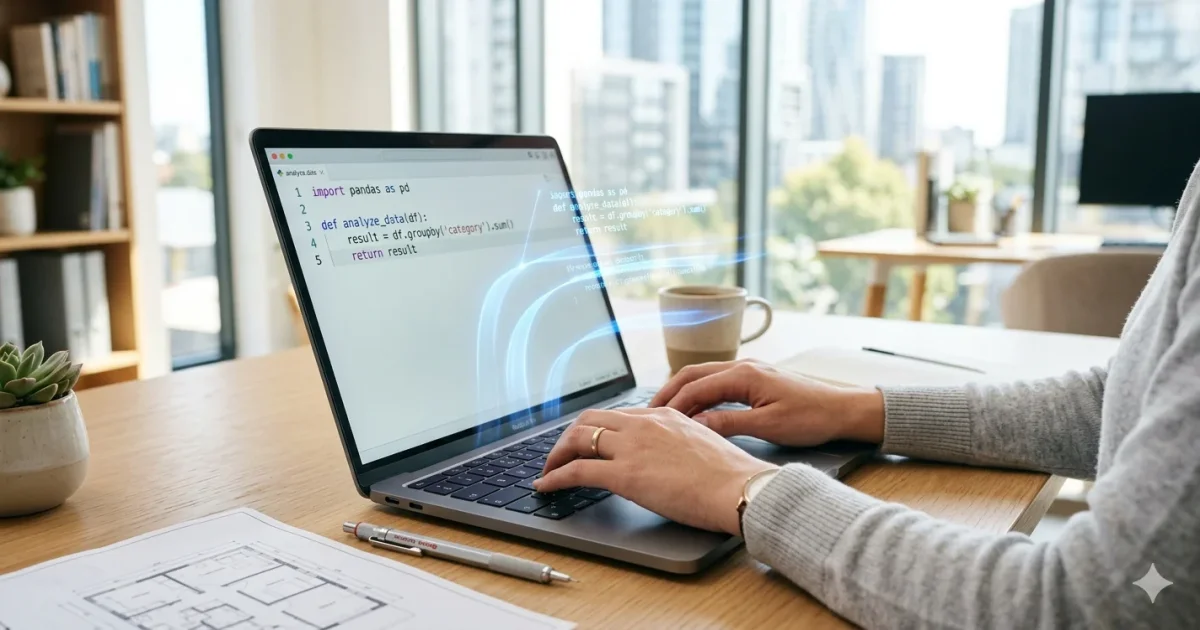
Vibe coding is the practice of using AI tools like Cursor, GitHub Copilot, and similar code generators to write software faster. The developer prompts the AI, reviews what it generates, catches the subtle bugs, and ships production-ready code in roughly half the time.
What vibe coding actually looks like in practice
A developer using vibe coding does not just accept whatever the AI suggests. They prompt strategically, review every line, understand what the AI got wrong, and fix it. Good vibe coders are faster not because the AI writes perfect code, but because they spend less time on boilerplate and more time on the parts that matter.
Think of it like an architect using CAD software. The tool speeds up drafting, but the architect still makes all the design decisions. If you are building an AI product yourself, our guide on how to build an AI MVP in 4 weeks shows vibe coding in action during a real sprint.
When vibe coding works well
MVPs and prototypes. When you need to validate an idea quickly, vibe coding lets you ship a working product in weeks instead of months. The code does not need to be perfect. It needs to work, be reasonably clean, and be shippable.
Feature sprints. Adding a new dashboard, building a CRUD interface, wiring up API endpoints. These are well-understood patterns where AI-generated code is reliable and the developer can move fast.
Boilerplate and scaffolding. Setting up project structures, writing tests for existing code, generating documentation. Tasks where the pattern is predictable and the risk of subtle bugs is low.
When vibe coding will hurt you
Regulated industries. If your code needs to pass compliance audits (healthcare, fintech, defense), you need every line to be deliberate and auditable. AI-generated code is harder to explain to an auditor than hand-written code.
Complex business logic. Payment processing, transaction atomicity, distributed system coordination. These are areas where subtle bugs cost real money. The AI does not understand your business rules the way a senior engineer does.
Performance-critical paths. If you are optimising for milliseconds (real-time systems, high-frequency data processing), AI-generated code is usually "good enough" but not optimal. Hand-tuned code wins here.
The hybrid approach most teams use
In practice, most of our teams use a mix. AI-assisted for scaffolding, tests, and boilerplate. Hand-crafted for business logic, security-sensitive code, and performance-critical paths. This gives you the speed benefit without the risk. It is worth noting that the developer still needs deep context about your product and industry to use these tools effectively.
At Workforce Next, you choose the engineering style. We match developers who are comfortable with whichever approach you prefer. You can hire a vibe code engineer who already knows how to pair with AI tools, or go with a traditional product engineer who hand-crafts everything.
How do you screen for a developer who is actually good at vibe coding?
The difference between a senior developer and a great vibe coder is not how fast they type a prompt. It is how critically they read what the AI gives back. Four signals we look for when matching vibe code engineers:
They read diffs carefully. Ask them to review a 200-line AI-generated PR in front of you. Strong candidates flag subtle issues (off-by-one errors, wrong null checks, incorrect async handling) that look fine at a glance. Weak ones just skim and approve.
They prompt with context, not wishes. "Write a login form" is a weak prompt. "Here is our auth middleware, our validation helpers, and our design-system button component. Write a login form that uses all three" is a strong one. Output quality tracks directly with how much context the prompt includes.
They know when to stop and write by hand. Good vibe coders recognize when the AI is going in circles (editing the same file three times, introducing new bugs as fast as it fixes them). They switch to hand-writing the tricky part and come back to AI assistance once past the hard bit.
They treat AI output as a draft, not an answer. Every function goes through a read, test, refactor cycle before it ships. The AI is a typing assistant, not a decision-maker. See our full AI developer interview questions for the screening framework we use.
What tools should a vibe coder be fluent in by 2026?
The stack stabilized around four tools by early 2026. Expect a serious vibe code engineer to be fluent in at least three of them:
Cursor or Claude Code. Primary IDE layer. Cursor for heavier project-wide context and explicit chat, Claude Code for terminal-native agent work. Most developers use one as the daily driver and the other for specific tasks.
GitHub Copilot. Inline autocomplete. Useful for the small stuff (type signatures, boilerplate, next-line suggestions) even if Cursor or Claude Code is the main tool.
v0 or similar UI generators. For UI scaffolding when the design is simple enough to describe in a prompt. Outputs React and Tailwind that usually needs cleanup but gets you to a working UI shell fast.
A review-and-eval habit. Not a specific tool, but a habit of running tests before and after every AI-driven change, and of diffing generated code against prior working versions to catch silent behavior changes.
A developer who uses none of these, or "Copilot and nothing else," is not really vibe coding. They are using autocomplete. Talk to us and we will figure out the right fit for your team.