
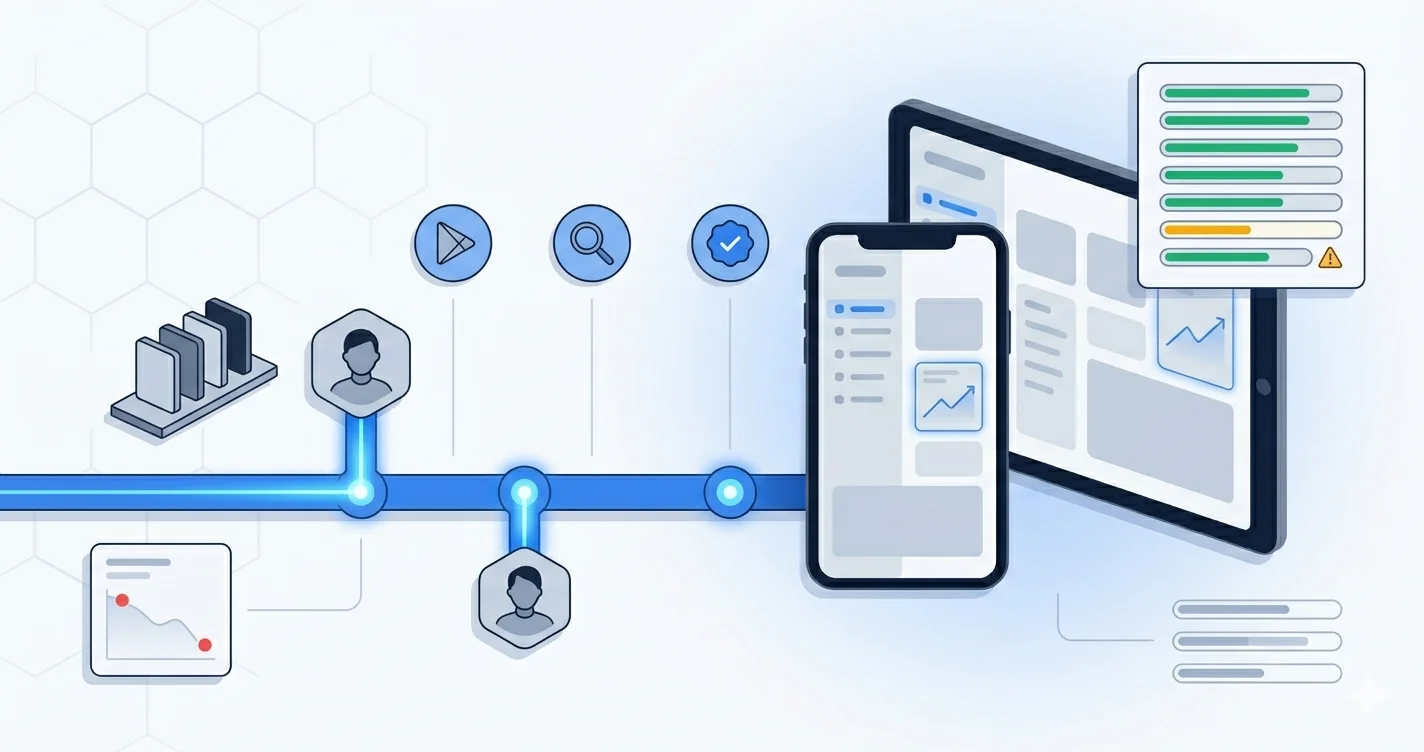
A remote mobile app testing team in 2026 is best structured as a small dedicated pod, not a single tester. Hiring this pod from India costs USD 12,000 to 18,000 per month all-in for three engineers, compared to USD 35,000 to 50,000 per month for an equivalent US team.
A mobile testing pod is a small, ongoing QA team focused specifically on iOS and Android apps. Unlike a generic web QA hire, a mobile testing engineer must understand real-device fragmentation, App Store and Play Store review processes, mobile-specific automation frameworks, and crash analytics.
This guide covers the pod structure we recommend, the tools the team should already know, the screening loop, and cost benchmarks. For the broader software testing team conversation across web, API, and mobile, see our parent pod hiring guide.
What does a mobile testing pod look like?
The right shape for most growing app teams is three engineers covering complementary skills. Hiring a single all-rounder almost always under-delivers; mobile QA is wide enough that one person cannot keep up.
| Role | Owns | India cost (all-in / month) |
|---|---|---|
| Manual QA Lead | Release readiness, exploratory testing, regression sign-off, App Store and Play Store submission discipline | USD 4,500 to 6,500 |
| Mobile Automation Engineer | Appium / Maestro / XCUITest / Espresso suites, CI integration, flake reduction, performance regression catching | USD 5,000 to 7,000 |
| Accessibility + Performance Specialist (part-time) | VoiceOver and TalkBack audits, dynamic-type sweeps, battery and memory profiling, crash-rate triage | USD 2,500 to 4,500 (half-time) |
A senior mobile QA engineer from India costs USD 4,500 to 7,000 per month all-in. Add 30 to 40% for the pod overhead (real-device subscriptions, cloud farm credits, the fractional QA lead), and you arrive at the USD 12,000 to 18,000 monthly band for the full three-person team.
What tools should the mobile testing team already know?
2026 has consolidated around a small set of mobile testing tools. A senior candidate should be fluent in most of these without ramp-up.
Test automation frameworks
- Appium: cross-platform standard, especially for hybrid and React Native apps
- Maestro: lighter-weight modern alternative, faster to write and run, good fit for greenfield teams
- XCUITest: native iOS automation, written in Swift, lives in the same Xcode project as the app
- Espresso: native Android automation, written in Kotlin or Java, fast and reliable for in-process tests
- Detox: gray-box testing for React Native, good for teams already on RN
Real device strategy
Real devices catch bugs simulators miss: thermal throttling, battery drain, network handoff, biometric prompts, real camera and microphone behaviour. The pragmatic 2026 split is a small in-house device shelf for daily testing plus a cloud farm for breadth.
- BrowserStack App Live: largest device catalog, mature debugging tools
- Sauce Labs Real Device Cloud: strong CI integration, useful when you already use Sauce for web
- AWS Device Farm: cost-effective for high-volume parallel runs in CI
- In-house shelf: typical setup is 3 iPhones (one current, one mid-range, one oldest supported), 4 to 6 Android devices spanning Samsung, Pixel, Xiaomi, OnePlus across version 11 to current
Crash analytics and observability
- Firebase Crashlytics: free, deep, the de-facto standard for production crash triage
- Sentry: better source-map and breadcrumb workflow, good when web and mobile share a Sentry org
- Instabug: in-app bug reporting with screen recording, useful during private beta
- App Store Connect Metrics and Play Console Vitals: official store-side dashboards for crash rate, ANR, battery and memory baselines
Beta channels and release readiness
- TestFlight: Apple's beta distribution, supports up to 10,000 external testers
- Play Internal Testing and Closed Track: Android's equivalent, integrated with Play Console
- App Store Connect submission discipline: senior QA leads should know the top 10 reasons reviewers reject apps and screen for them before submission
- Play Console release rollout strategy: staged rollouts (5% → 20% → 50% → 100%) with crash-free rate gates
How is mobile testing different from web testing?
Three differences matter when you hire and screen.
Device fragmentation is real and cost-borne
The web has a manageable browser matrix (Chrome, Safari, Firefox, Edge) and roughly two operating system families. Android alone has thousands of device-OS-vendor combinations. A senior mobile QA engineer must be able to argue which devices are worth testing, where to use cloud farms, and where to skip testing entirely. This judgement is hard to teach.
Release cadence is gated by external reviewers
Apple and Google review every release. A failed review can stall a feature launch by 3 to 7 days. Senior mobile QA leads check screenshots, metadata, privacy disclosures, and known-rejection patterns before submission, not after. This is a different mental model than "deploy on Friday and roll back if needed."
Performance, battery, and memory are first-class concerns
A web app can leak memory and the user reloads. A mobile app that leaks memory crashes mid-session and shows up in your Core Web Vitals equivalent as user-facing reliability. Mobile QA engineers must use Xcode Instruments, Android Studio Profiler, and the platform vitals dashboards as part of release sign-off, not as occasional debugging.
How do you screen mobile testing engineers from India?
The same four-stage loop we use for software testing teams, with mobile-specific signals.
Stage 1: portfolio audit (45 minutes)
Ask for a real public app on the App Store or Play Store the candidate has tested in production. Pull up the app's listing, scroll the recent crash-free rate (visible on Play Store via store stats and on App Store via Connect for the team), and ask the candidate to walk through their last release: what they tested, what they caught, what they missed.
Stage 2: technical interview (60 minutes)
Strong questions for senior mobile QA candidates:
- Walk through how you would test a deep link that opens a specific screen on iOS and Android, including cold start, warm start, and background restoration
- How would you reproduce a crash that only occurs on a specific Android OEM (e.g., Xiaomi)? What tools, what data?
- Describe your process for getting a release through App Store review without a rejection, including the top 3 risks you flag pre-submission
- If the team's automation suite has 5% flake rate, what is your action plan to bring it under 1%?
Stage 3: paid trial (1 to 2 weeks)
Pay them a real rate to write one test suite or do one full release sign-off in your codebase. This is the highest-signal step; you will see how they handle real device-lab access, real CI, real reviewer pushback. Use our verification checklist for what to look for.
Stage 4: reference and incident signal
Two reference calls. Ask specifically about App Store rejections they handled, production crashes they investigated, and one release they delayed because they caught something late. The best QA engineers have all three stories ready.
Where do remote mobile testing teams fall short?
Honest assessment of where a senior US-based mobile QA team will out-perform on day one:
- Same-time-zone with US engineering. India works partial overlap with US East Coast and minimal overlap with US West Coast. If your incident model needs a tester on call during US business hours for a high-stakes launch day, plan for a one-engineer US-hours rotation or hybrid pair.
- iOS device-policy edge cases. App Store review reasons evolve weekly. US-based QA leads sometimes have closer informal channels into App Store policy. We compensate with a strict pre-submission checklist and 48-hour soak period.
- Day-one Apple platform releases. iOS 19, visionOS updates, new Apple Silicon hardware, those tend to land in US teams first. India catches up within 1 to 2 release cycles.
For the typical mobile testing scope (B2B SaaS, fintech, marketplace, healthcare, travel apps), none of these are deal-breakers and the cost difference is significant.
What does the engagement look like at Workforce Next?
The standard model is a managed mobile testing pod that plugs into your sprint cadence. SethAI matches the engineers to your stack (React Native, Flutter, native iOS, native Android), your CI tools (Bitrise, Codemagic, Fastlane, GitHub Actions), and your existing dev pod if you have one. The pod operates inside your Slack, your Jira or Linear, and your TestFlight and Play Console.
If you also need cross-platform mobile developers, we staff that as a paired pod. See our QA engineers page, and the iOS developer and Android developer pillars for engineering-side roles. The full managed offshore team operating model is documented on our india-handled overview.
Frequently asked questions
See the FAQ block below for quick answers on pod size, framework choice, real-device strategy, and engagement structure.
Ready to start? Book a 30-minute scoping call on our contact page and we will share matched senior mobile QA profiles within 5 business days, no fee until you hire.