
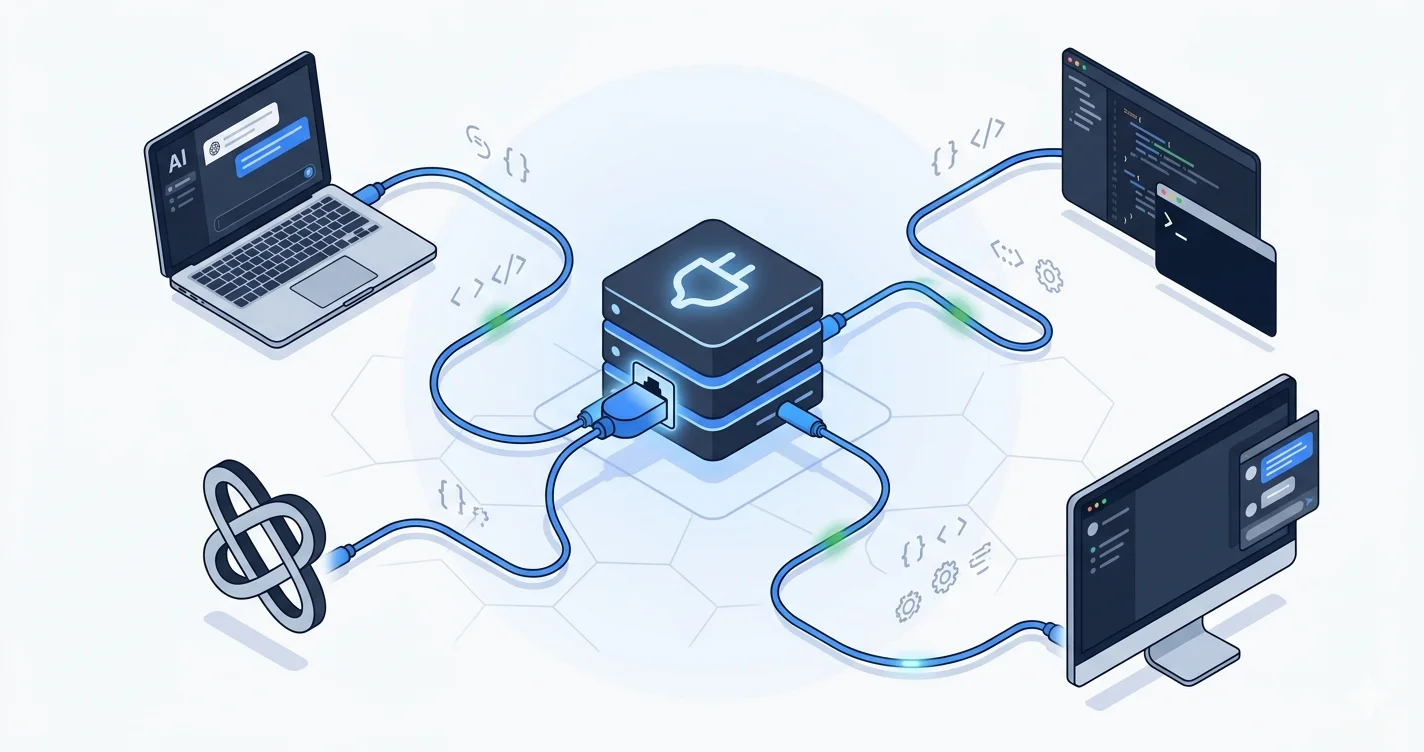
If you have built any kind of internal AI tool over the last two years, you have hit the same wall. The model is good. The agent loop sort of works. But every integration with an internal API, every database connection, every tool the agent should be able to call, is bespoke code written from scratch. The next project you start, you write the same plumbing again with subtly different security and observability choices, because the previous code does not quite fit.
The Model Context Protocol fixes that. In 2026 it is the answer to "how do I let my LLM client talk to my internal systems," and it is now the integration layer most serious AI products are being built on. This post covers what MCP is, why it matters, when you need a dedicated MCP developer, what one costs, and how to screen for one.
What is MCP and why does it matter in 2026?
MCP, the Model Context Protocol, is an open standard introduced by Anthropic in late 2024 that defines how LLM clients communicate with servers that expose tools, resources, and prompt templates. Think of it as USB for AI: a single, well-specified plug shape that any client can connect to, and any server can implement, without bespoke adapters in between.
Before MCP, every integration between an LLM and an internal tool, database, or API was custom. Each agent framework had its own tool format. Each LLM client had its own way of calling tools. If you wanted Claude to query your Postgres, the same Postgres to be readable by Cursor, and an internal agent loop to also use it, you wrote three different integrations. The work was tedious, the security review was inconsistent, and the second time you tried to onboard a new client, you reached for a rewrite.
MCP collapses all of that into one server. You implement the protocol once. Claude Desktop reads from your server. Cursor calls the same tools. Your custom agent built on LangChain or LangGraph uses the same exposed surface. The protocol became practical the day major clients started shipping native support, and 2026 is the year it became the default integration layer for production work.
How does an MCP server actually work?
An MCP server exposes three kinds of things to clients:
- Tools. Functions the LLM can call: "search the wiki," "read row 42 from this table," "create a Linear ticket." Each tool has a name, a JSON schema for its inputs, and a typed response.
- Resources. Data the model can read: documents, database rows, log entries. Identified by URI and returned as content the model can reason over.
- Prompts. Reusable prompt templates the client can let users invoke: "explain this codebase," "draft a release note from these tickets." Useful for surfacing common workflows in the client UI.
The server speaks one of three transports: stdio for local desktop integrations like Claude Desktop, HTTP for hosted servers, and SSE (Server-Sent Events) for streaming responses over HTTP. The transport choice is partly deployment context and partly latency tradeoff. Production servers we ship are usually HTTP plus SSE for streaming, with stdio support added if a desktop client needs to embed.
Authentication is not in the early MCP spec at the protocol level, which is the single biggest source of confusion for first-time MCP developers. You implement auth at the transport layer: bearer tokens for HTTP, mTLS where you control both ends, or session tokens vended by an OAuth flow for hosted multi-tenant servers. The MCP working group is converging on a standard authorization extension, but as of mid-2026 most production servers still pick their own pattern.
When should you hire an MCP developer instead of a generalist AI developer?
The honest decision matrix:
- Hire an MCP developer when: you have multiple tools to expose, multiple data sources to wire in, you want the same surface usable from Claude Desktop and Cursor and a custom agent, or you are building a multi-tenant SaaS product where customer agents need to call into your platform.
- Stay with a generalist AI developer when: your AI feature is a single LLM call with one or two simple tool calls bolted on, you have no plans to support multiple LLM clients, and the agent surface is not a product on its own.
The line is roughly: are you building an integration layer, or are you building a feature? Integration layers benefit from the protocol; features can ship without it. We staff the integration cases through our dedicated MCP developers, often paired with LangChain or RAG developers for the agent loop and retrieval sides. For pure feature work, our AI developers are the right hire.
What does an MCP developer actually build?
The job description matters more than the title. A real MCP developer ships:
- An MCP server that exposes a defined set of tools, resources, and prompts to LLM clients, with deterministic behavior and clear errors.
- Tool definitions with strict input schemas and well-typed outputs that do not leak implementation detail back to the model.
- Authentication and authorization that handles single-tenant and multi-tenant cases without papering over either.
- Transport implementation appropriate to the deployment: stdio for embedded use, HTTP and SSE for hosted servers, with proper backpressure and reconnection handling.
- Wiring to internal data sources: REST APIs, GraphQL, Postgres, vector stores like pgvector, Pinecone, or Weaviate.
- Eval suites that exercise tools and verify behavior continues to work as models, prompts, and the protocol evolve.
- Observability: tracing every tool call, capturing prompt and response artifacts where appropriate, defining error budgets and SLOs.
- Defense against AI-specific attack vectors: prompt injection, indirect injection through retrieved content, tool-call abuse, data exfiltration through over-broad tool surfaces.
- Version compatibility as the spec evolves, including capability negotiation and graceful client downgrade paths.
The full version of this list, with an opinionated take on each item, is on the hire MCP developers page.
How much does an MCP developer cost in 2026?
Pricing varies by region. Senior MCP developers from India, working full-time and dedicated, typically cost between $7,000 and $12,000 per month all-in to the client. The numbers are slightly higher than for a generalist AI developer because the bench is smaller; engineers with shipped MCP server experience are still rare globally. The full all-in calculation for senior India hires is in what you should pay a senior Indian developer in 2026.
Latin American MCP developers run roughly 30 to 60 percent more than India numbers, with a smaller available pool and stronger US timezone overlap. Eastern European MCP developers run higher again, with the deepest backend rigor of the three regions but the smallest AI-specific bench. A US-based senior MCP developer, where you can find one, runs $280,000 to $380,000 fully loaded. The cost gap is the reason most US companies are staffing MCP work offshore. The full regional breakdown is in what developers US companies outsource most in 2026.
Build engagements (a one-time MCP server delivery rather than a hire) are often quoted as a fixed-fee project, typically 4 to 8 weeks of work. We use this model when a customer needs a first MCP server in production and is not yet sure whether ongoing MCP work justifies a full hire.
How do you screen for a real MCP developer?
There is a specific kind of MCP developer worth hiring and a much larger group of generalists who have read the spec but not shipped against it. The screening signals that distinguish them:
- Real MCP shipping experience. Ask the candidate to walk through an MCP server they actually built. Strong candidates explain transport choice, auth model, and what they would change. Weak ones quote the README.
- Tool definition design instinct. Give them a feature spec and ask them to design the MCP tools for it. Strong candidates produce small, deterministic tools with clear errors. Weak ones produce a single mega-tool that does everything.
- Auth and tenancy thinking. Ask how they would build a multi-tenant MCP server. Strong candidates lead with token scoping, per-tenant quotas, and audit trails. Weak ones lead with the happy path.
- Eval discipline. Ask whether they have shipped an MCP server and how they verify it still works as models change. Strong candidates have eval suites. Weak ones have manual smoke tests.
- Cross-stack literacy. Good MCP developers understand the client side. Screen for engineers who have used MCP from Claude Desktop, Cursor, or a custom agent loop, not just built servers in isolation.
- AI-specific security awareness. MCP servers face a new class of attacks: prompt injection, indirect injection through retrieved content, tool call abuse. Screen for engineers who think in terms of trust boundaries, not just standard input validation.
If you are not running this kind of screen yourself, the SethAI match report covers all six signals plus the longevity layer that determines whether the engineer stays past the first three months.
Which clients support MCP today?
The supported-client list moves quarterly. As of mid-2026:
- Claude Desktop and the Claude API support MCP natively and were the launch surface for the protocol.
- Cursor and Windsurf have first-class MCP support for tool integration and resource access.
- Agent frameworks including LangChain, LangGraph, and AutoGen have MCP adapters that let agents call MCP servers as part of their tool inventory.
- Several major dev tools added MCP integration in 2026 to let engineers query internal systems from inside their editor.
- The OpenAI ecosystem has begun adopting compatible patterns through its function-calling and tool-use formats, though full MCP server compatibility is still uneven.
The exact compatibility list moves quarterly, which is part of why eval discipline matters. A working MCP server today should be tested against new client versions on a continuous schedule, not abandoned after launch.
How do you ship your first MCP server?
The path that works, for a team that has not built one before:
- Define the smallest useful surface. Pick three to five tools and one or two resources. Resist the temptation to expose everything. The first server should solve one workflow well, not be a complete API mirror.
- Build it as a hosted HTTP+SSE server, even if you also want stdio later. Hosted is easier to test, easier to deploy, and easier to share with the rest of the team. Stdio for desktop embedding is a follow-up that takes a few days once the core is working.
- Run it against Claude Desktop and at least one other client before considering it shipped. Two-client testing catches the cases where you accidentally relied on Claude-specific behavior. The post on choosing an AI agent framework is the companion read for the agent side of the stack.
If you want to skip the bootstrap phase, our MCP developers ship a production-ready first server in a 4 to 8 week build engagement. The deliverable is a tested server, an eval suite, deployment scripts, and documentation handed to your team so the engineering knowledge transfers.
Final word
MCP is one of the rare protocols that solved a problem most teams did not realize they had until they saw the alternative. If you are building an AI product where the LLM needs to call into your systems, and especially if you are building one where multiple clients need that same access, MCP is now the obvious starting point rather than a brave choice. The remaining question is who builds it. Talk to us if you want a senior MCP developer matched in 48 hours, or if you want a fixed-scope build engagement for your first server.