
An enterprise Node.js developer is the engineer who builds and runs the JavaScript-or-TypeScript backend that sits between your product, your data, and the rest of the world. They design APIs, ship real-time features, integrate third parties, run microservices, and own the BFF layer that powers your web and mobile clients. In 2026 this is one of the most common backend roles in the industry, and also one of the most misunderstood.
This post lays out what these engineers actually do, how the seniority ladder works, and how to scope a hire so you do not end up with a generalist where you needed a specialist. If you are ready to hire, jump straight to our Node.js hiring page or read our India hiring guide for cost benchmarks.
What is a Node.js developer in an enterprise context?
A Node.js developer is a backend or full-stack engineer whose primary runtime is Node.js, typically with TypeScript. In an enterprise context, that means the engineer owns server-side code that powers customer-facing products, internal tools, or both, with real uptime, security, and compliance requirements behind it.
The "enterprise" part matters. A Node.js developer at an early-stage startup might own one Express service end to end. The same engineer at an enterprise might own a NestJS module inside a microservices estate, with code review gates, security scans, audit trails, and a release train they have to merge into. Both are real roles. They demand different instincts.
What does an enterprise Node.js developer actually do?
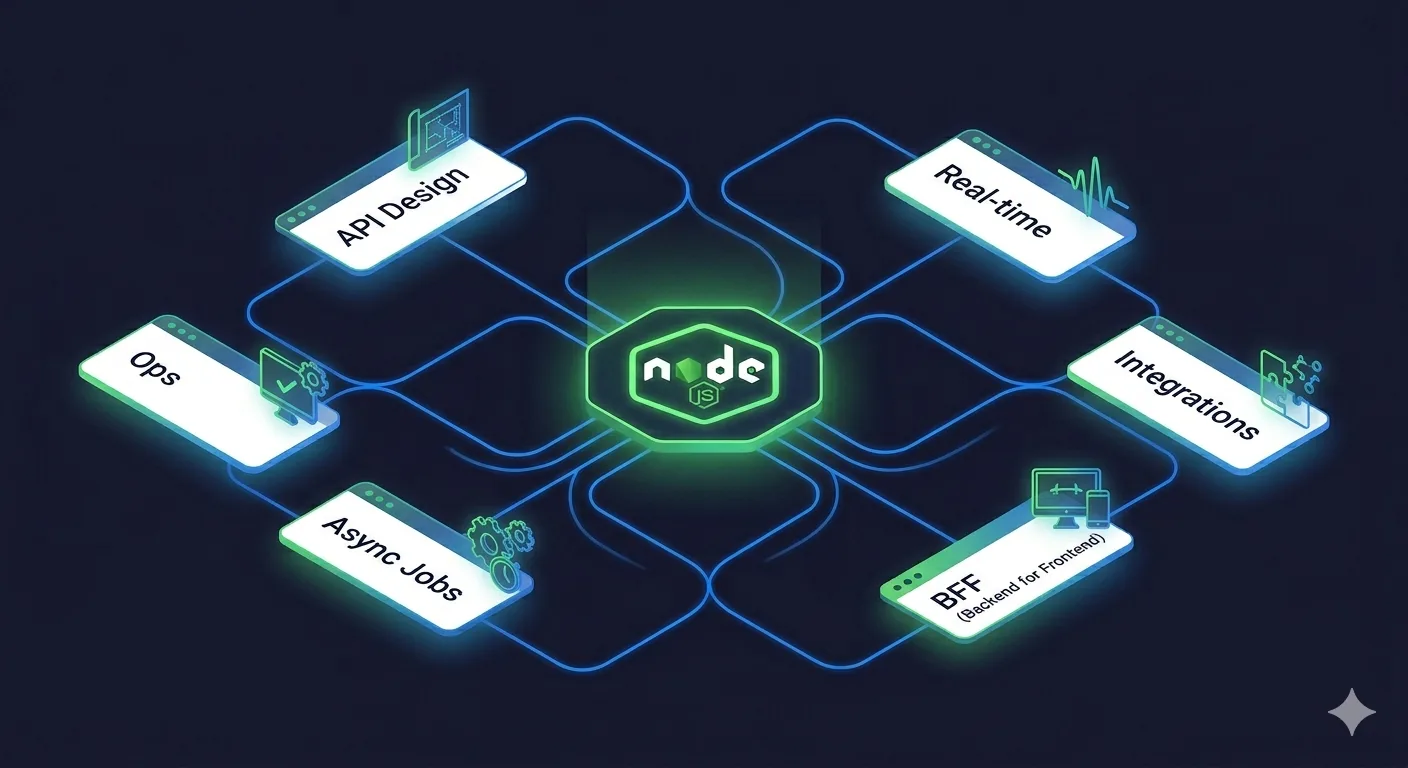
The day to day work falls into six buckets. Most engineers spend time across all six in any given quarter:
- API design and delivery. REST and GraphQL endpoints, with proper versioning, error envelopes, idempotency, pagination, and OpenAPI contracts. Most production APIs we see are built in NestJS or Express, with Fastify showing up where latency budgets are tight.
- Real-time features. WebSockets, Server-Sent Events, and Socket.io for chat, notifications, dashboards, presence, and collaborative editing. Real-time at scale needs sticky sessions, horizontal scaling, and back-pressure handling that tutorials skip.
- Integration glue. Webhooks, third-party APIs, identity providers, payments, messaging, and the dozens of internal services that an enterprise stack accumulates. Node.js wins here because async I/O is cheap and JSON is native.
- BFF layers. The backend-for-frontend that sits between a Next.js or React app and your downstream services. The BFF shapes data for the client, hides domain complexity, and centralizes caching and auth.
- Async work pipelines. Background jobs, schedulers, and event-driven workflows on BullMQ, Temporal, AWS Lambda, or Kafka consumers. This is where most "the API got slow" problems actually get solved.
- Operational ownership. Logs, metrics, tracing, on-call rotation, incident response, and the post-mortems that follow. Senior Node.js engineers spend at least 20% of their time here.
What does the Node.js seniority ladder look like?
You will see four common levels. Hire against the level your work actually needs, not the title that sounds good in a JD.
| Level | Years | Owns | Typical scope |
|---|---|---|---|
| Junior (L1) | 0 to 2 | Tickets, small features | CRUD endpoints, bug fixes, test coverage, code review apprenticeship |
| Mid (L2) | 2 to 5 | A service or module | API design within a domain, integration work, on-call rotation, mentoring juniors |
| Senior (L3) | 5 to 8 | A subsystem | Architecture for a domain, performance and security work, technical interviewer, cross-team collaboration |
| Lead / Staff (L4+) | 8+ | An estate | Multi-service architecture, platform decisions, hiring bar, RFCs, production incident leadership |
Most enterprise teams need one L3 senior for every two to three L2 mid-level engineers, with an L4 lead for any group of five or more. Stacking too many juniors without senior coverage is the most common mistake we see when teams try to save on hourly cost.
What technical skills should an enterprise Node.js developer have?
Below the role names, the actual technical surface area is consistent. We screen for the following on every Node.js hire:
- TypeScript by default. Strict mode, interface design, generics, discriminated unions. Engineers who default to
anywill not survive a real codebase. - Async correctness. Promise.all vs sequential awaits, when to use worker threads, and why a CPU-bound function freezes every request on the same process.
- Framework judgment. Express, NestJS, and Fastify each have a sweet spot. Strong candidates can defend a pick for a given scenario, not just recite features.
- Database depth. PostgreSQL or MongoDB at minimum, with connection pooling, indexing, query plans, and migration tooling like Prisma, Drizzle, or TypeORM.
- Observability. Structured logging, metrics, distributed tracing with OpenTelemetry, and APM tools like Datadog or New Relic.
- Security baseline. Input validation, JWT pitfalls, prototype pollution, SSRF, and npm supply-chain hygiene. Read our Node.js security checklist for the full surface.
- Production deployment. Docker, Kubernetes, AWS Lambda, GCP Cloud Run, and CI/CD on GitHub Actions or GitLab.
For a deeper view of how performance work specifically maps to the role, see our Node.js performance and scaling checklist.
How is a Node.js developer different from a generic JavaScript developer?
The titles get used interchangeably. They are not the same job. A JavaScript developer might write React components, jQuery snippets, or browser-side logic. A Node.js developer runs JavaScript on the server, which means a different mental model entirely.
- Runtime. Server-side V8 with libuv and the event loop, not a browser DOM.
- Concurrency. One process serves thousands of concurrent connections via async I/O. Browser code rarely thinks about concurrency at all.
- Failure mode. An unhandled promise rejection in a browser annoys one user. The same in a Node.js process can take down every customer on that pod.
- Tooling. npm at scale, lockfile hygiene, supply-chain attacks, and CVE response are server problems first.
- Operational surface. The Node.js engineer is on the page when a service fails at 3am. Most frontend engineers are not.
If you are hiring for a backend that needs to be on call, hire a Node.js specialist. If you need someone to build UI in React, hire a frontend engineer. The overlap is smaller than it looks.
When does an enterprise need a dedicated Node.js engineer vs a full-stack generalist?
Three signals say you need a dedicated specialist:
- Your product depends on real-time or high-concurrency features. Chat, notifications, live trading, multiplayer, IoT ingestion. These break in subtle ways without specialist knowledge.
- You have a microservices or event-driven architecture. See our Node.js microservices guide for what this actually demands.
- You are running on the JVM or Python and the cost of running a JS team alongside is real. The decision matrix is in Node.js vs Java vs Go for enterprise backends.
If none of those apply, a full-stack generalist who happens to ship Express endpoints is fine. Save the specialist budget for where it earns its keep.
How do you scope a Node.js hire so you get the right person?
Use a one-page brief before posting. We ask every customer to fill in:
- What service or domain will the engineer own end to end?
- What is the traffic shape: peak RPS, concurrent connections, p95 latency target?
- Which frameworks and databases does the existing codebase use?
- Is there an on-call rotation? What is the response SLO?
- Who are the engineer's two closest collaborators, and what do they expect?
- What does success look like 90 days in?
If you cannot answer those, the job is not ready to hire for. The brief itself filters out vague work that is better solved by a contractor or by deleting scope. When the brief is sharp, the matching gets fast.
Where does Workforce Next fit in?
We place pre-vetted Node.js engineers from India for enterprise teams in the US, UK, EU, and APAC. Every engineer is screened by SethAI for technical depth, async reasoning, and longevity, then by a human panel for the scenario you described in your brief. Most placements are senior or lead.
If you want to see costs, sample profiles, and engagement models, start at hire Node.js developers or talk to us about your role. We typically ship a shortlist within 48 hours.