
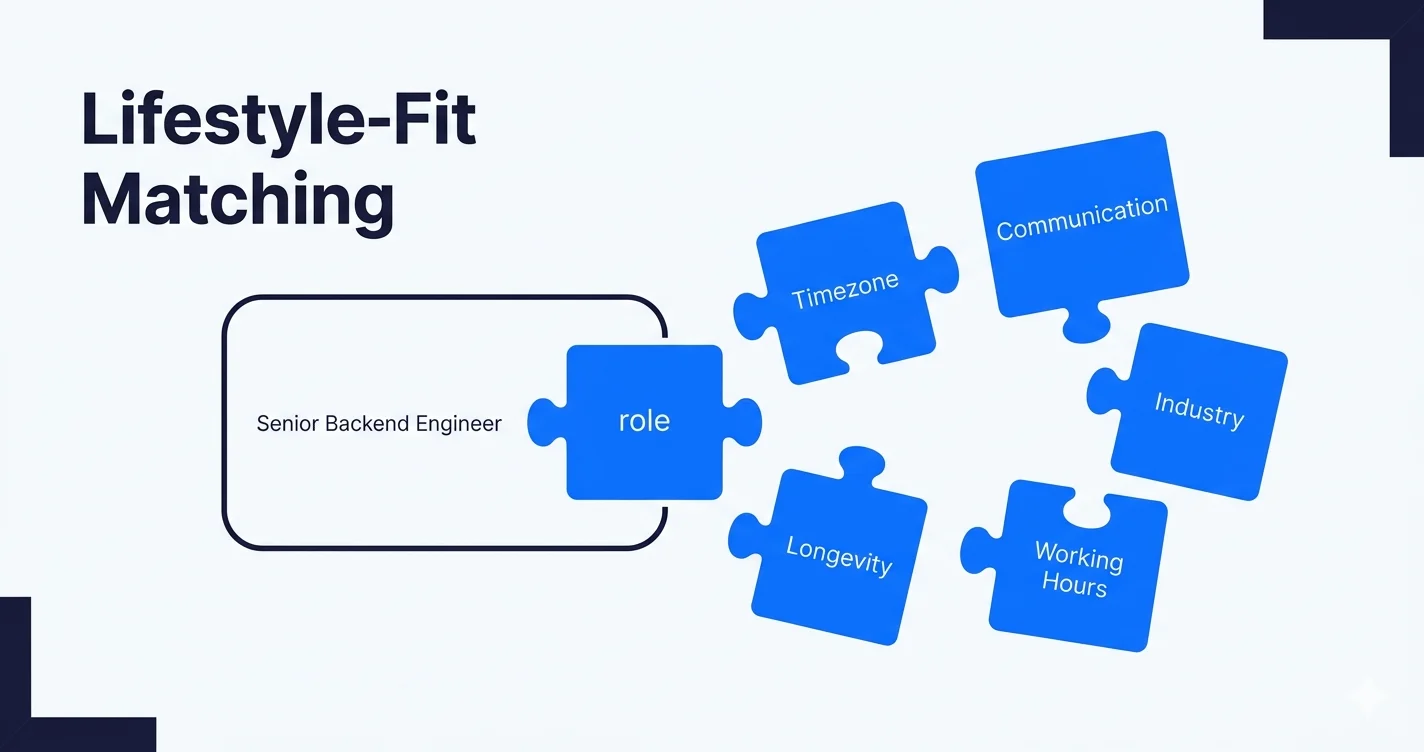
Lifestyle-fit matching is a second-generation AI hiring approach that evaluates developers across timezone, communication style, career goals, working hours, and domain context, not just technical skills. It exists because skills-only AI matching keeps placing the wrong person in the right job.
This post defines the category, explains where the first generation of AI hiring tools fails, lists the 12 lifestyle parameters that actually predict a successful hire, and shows when lifestyle-fit matching is and is not the right choice for your team.
What is lifestyle-fit matching?
Lifestyle-fit matching is the practice of pairing a developer to a role using behavioral, contextual, and lifestyle parameters alongside technical skills. Instead of asking "does this candidate know React?" the matching system also asks: Do they work the hours my team actually collaborates in? Do they communicate the way my team communicates? Have they shipped in my industry? Will they still be here in 18 months?
This is different from "culture fit" hiring, which is often subjective and frequently used to justify bias. Lifestyle-fit matching is explicit and parameterized. Every signal is a defined variable with a defensible measurement method, not a vibe check by a hiring manager.
Why does skills-only AI matching keep failing?
The first generation of AI hiring tools (Eightfold, SeekOut, HireEZ and similar) was built on a simple thesis: parse resumes, extract skills, match against job descriptions. This worked when the job market was the constraint. It no longer is.
In 2026, the constraint is retention and fit. A candidate who technically qualifies but cannot overlap with your team's working hours will frustrate everyone by month three. A senior developer with no context in your industry will ship generic code and miss domain edge cases. A strong engineer who communicates in long asynchronous paragraphs will create friction on a team that runs on 5-minute standups.
Skills-only matching cannot see any of this. It was designed for a different problem. That is why teams using Gen 1 tools still report the same issues they had before AI hiring existed: developers leaving at month six, integration friction, domain onboarding taking longer than expected.
What are the 12 parameters that make up lifestyle-fit?
Any serious lifestyle-fit matching system should evaluate at minimum these 12 parameters. When you audit an AI hiring tool, ask the vendor which of these they actually measure.
- Timezone overlap. How many hours per day does the candidate genuinely work when your team is also working? Not "India hours" as a label, actual overlap in hours.
- Preferred working hours pattern. Is the candidate comfortable with 4+ hours of synchronous work, or are they async-first? Mismatched working styles fail even when timezones overlap.
- Communication style. Do they write short Slack messages or long-form documentation? Do they prefer video or text? This predicts integration speed on your specific team.
- Standup and meeting cadence tolerance. Some engineers thrive with daily standups. Others lose a day of focus to every meeting. Match to your cadence.
- Domain and industry context. A developer who has built payment rails for two years is a different hire from a developer who has built fleet-tracking dashboards, even if both write Java. Industry context compounds.
- Product-type familiarity. B2B SaaS, consumer mobile, internal enterprise tools, and AI-first products each have different patterns. Past experience in your product type reduces ramp-up from months to weeks.
- Company-stage comfort. A developer from a 5,000-person enterprise often struggles in a 15-person startup, and vice versa. Stage fit is underrated.
- Career trajectory alignment. Is the candidate looking for ownership or execution? Growth into leadership or deep IC work? Aligning your role with their trajectory is the strongest retention signal.
- Feedback style. Direct and blunt, or warm and contextual? A mismatch here creates friction that looks like a technical problem but is not.
- AI-tool comfort. Does the candidate use Cursor and Copilot comfortably, or do they prefer hand-crafted code? This matters if you have opinions about engineering style.
- Longevity signals. Job-hopping patterns, reasons for leaving prior roles, stated career goals. Not used to discriminate, used to predict whether the match will survive to month 18.
- Working environment stability. Home office setup, internet reliability, personal schedule predictability. Practical factors that determine whether a candidate can actually show up reliably.
At SethAI we evaluate all 12 plus a handful of domain-specific signals depending on the role. Parameters are weighted differently for a fintech senior engineer than for an early-stage MVP builder, because the priorities are different.
How is lifestyle-fit matching different from Eightfold, SeekOut, and HireEZ?
The Gen 1 tools are not bad. They are optimized for a different buyer and a different era. Here is a direct comparison of how each approach handles the matching problem.
| Capability | Gen 1 (Eightfold, SeekOut, HireEZ) | Gen 2 Lifestyle-Fit (SethAI) |
|---|---|---|
| Primary signal | Skills and experience on resume | Skills plus 12 lifestyle parameters |
| Timezone handling | Location label | Actual sync-hours overlap calculation |
| Industry context | Keyword match on past titles | Depth-weighted product and domain history |
| Longevity prediction | Rarely addressed | Explicit retention signal scoring |
| Communication style | Not measured | Measured via writing samples and interview signals |
| Best for | High-volume enterprise sourcing | Mid-market and senior hires where fit matters more than volume |
| Typical outcome | Wide shortlist, manual filtering still needed | Narrow shortlist with fewer wrong matches |
If you are sourcing 200 junior engineers a quarter, Gen 1 volume tools are the right choice. If you are hiring a senior backend engineer who will be the third person on your team, lifestyle-fit matching avoids the most expensive failure mode, which is hiring someone who technically qualifies but cannot actually work with you.
When is lifestyle-fit matching the wrong choice?
Honest tradeoffs matter. Lifestyle-fit matching is not right for every situation.
High-volume junior sourcing. If you need to screen thousands of candidates for an entry-level pool, a skills-first Gen 1 tool is more efficient. Lifestyle parameters matter less when the role is defined by training rather than fit.
Short-term contract work. If the engagement is 4 weeks, retention signals are irrelevant, and you can tolerate more communication friction in exchange for speed. Gen 1 matching or a simple marketplace like Toptal is enough.
Roles where technical skill dominates everything. Certain specialist roles (pure research, deep infrastructure, highly regulated work) weight technical depth so heavily that lifestyle factors become secondary. You still want to check them, but they should not be the primary filter.
Teams that hire by interview panel, not by match. If your hiring process already extracts most of these signals through a rigorous multi-round interview, an AI matching tool is an optimization, not a transformation. You can skip lifestyle-fit tools and keep your existing process.
How does SethAI measure lifestyle-fit without being creepy?
This is the question every thoughtful CTO asks, and correctly. AI hiring tools have been sued (Eightfold faces a January 2026 class action alleging FCRA violations for compiling candidate profiles using external data without clear consent). The industry is under scrutiny.
SethAI's approach is deliberate on three fronts:
Explicit consent and transparency. Every candidate knows exactly which signals are being evaluated and why. Nothing is scraped from external sources without disclosure. No shadow profiles.
Parameters over personality. We measure behavioral signals (writing samples, communication cadence, stated preferences) rather than inferring personality traits from background data. A candidate who prefers async work is telling us that; we are not guessing from their college or their birthplace.
Human override on every match. SethAI produces a ranked shortlist. A human recruiter reviews every shortlist before it reaches a customer. The system recommends; people decide. This is documented in our SethAI product details.
What does a lifestyle-fit match look like in practice?
Example from a real engagement (details generalized). A US-based fintech startup needed a senior backend engineer. Gen 1 tools would have matched on "Python + FastAPI + payments" and returned hundreds of candidates.
SethAI's lifestyle-fit matching filtered for: 5+ hours of US Pacific overlap, prior work on ledger or transaction systems, comfort with short-form Slack communication, no history of changing jobs under 12 months, and career trajectory pointing toward senior IC rather than management. The shortlist came back with 3 candidates instead of 120. The customer interviewed all three, hired the second one, and the engineer is still there 14 months later.
The math that makes this work is not mysterious. Better parameters produce a smaller but higher-quality shortlist. The customer spends less time interviewing the wrong people. The hired engineer stays longer because the fit was real, not just technical.
Where lifestyle-fit matching is heading
Expect this category to split into two branches over the next 18 months. One branch will keep optimizing against resume data and try to infer lifestyle signals from it. The other (the branch we believe in) will go further into explicit behavioral measurement: structured interviews, writing samples, pair-programming signals, and real-world work simulations that measure fit before the offer is made.
The companies that invest in the second branch will own the high-fit, low-volume end of the market. The companies stuck in resume-inference will keep selling volume to enterprises that measure recruiting by pipeline size rather than by retention 18 months later. Both markets exist. They serve different buyers.
If you are hiring specialists where fit matters more than volume, talk to us about your role and we will show you what a lifestyle-fit match looks like for your specific team.