
Pick the wrong Node.js framework and you pay for it for years. The three frameworks worth taking seriously in 2026 are Express, Fastify, and NestJS. Each one is a real choice with a real fit. This post is the comparison we hand to engineering leaders before they greenfield a Node.js service.
If you already know which framework you want and need engineers, see our Node.js hiring page. For broader context on the role, read the role of a Node.js developer in enterprise applications.
What does each framework actually give you?
| Framework | Released | Style | What it gives you |
|---|---|---|---|
| Express | 2010 | Minimal middleware | A router, middleware chain, and almost nothing else. You wire the rest yourself. |
| Fastify | 2017 | Schema-first plugins | A faster router, JSON schema validation built in, plugin encapsulation, and serialization speedups. |
| NestJS | 2017 | Opinionated modular framework | DI container, decorators, modules, guards, interceptors, microservice transports, and a CLI. |
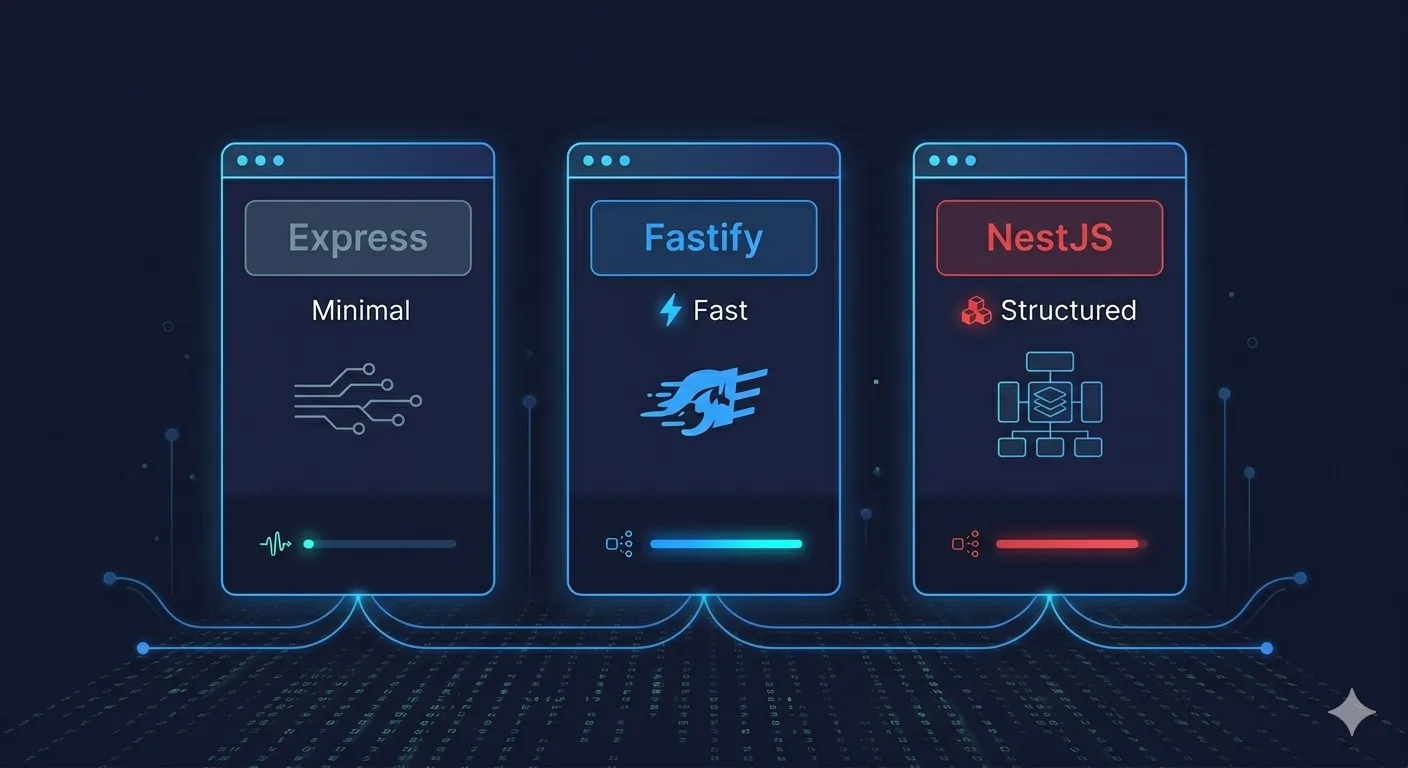
Express is a library you compose. Fastify is a framework you opt into. NestJS is a framework that opts you in. The further right you go, the more structure you get and the less freedom you have.
How do they compare on raw performance?
Benchmarks vary by workload, but the rough order in 2026 is consistent:
- Fastify: typically 2 to 3 times the throughput of Express on JSON-heavy endpoints, thanks to a faster router and schema-driven serialization.
- Express: the baseline. Plenty fast for most workloads. Bottleneck is rarely the framework.
- NestJS: depends on the underlying adapter. NestJS on Express matches Express. NestJS on Fastify gets most of Fastify's speed back.
Honest take: framework throughput rarely matters for an enterprise API. The database, downstream calls, and your business logic dominate. Pick on structure and team fit unless you are running a service measured in hundreds of thousands of RPS per pod.
When does Express still win?
Express is not legacy. Pick it when:
- The service is small. A BFF, a webhook handler, or a thin proxy. Express keeps lock-in low.
- You are migrating from or to something else. Express is the lingua franca. Every senior Node.js developer knows it.
- You want maximum control. No DI container, no decorators, no surprises. What you write is what runs.
- You are running on serverless and cold starts matter. A thin Express handler on Lambda is hard to beat.
- The codebase is already Express. Migrating just to migrate is rarely worth it.
The risk with Express is consistency at scale. With no opinions, every engineer reinvents middleware patterns. After 30 endpoints written by 5 different people, the codebase looks like 5 different services.
When does Fastify win?
Fastify earns its keep when:
- Throughput matters. High-RPS APIs, tight latency budgets, or expensive cloud bills tied to compute.
- You want schema-first APIs. JSON schema for request and response, validated and serialized at framework speed.
- You like the plugin model. Encapsulation, scoping, and explicit dependencies between plugins.
- You are building a thin service with rich routing. Fastify's routing is faster and more featureful than Express's out of the box.
The risk with Fastify is a smaller community than Express, fewer middleware packages with drop-in compatibility, and a learning curve around plugins and lifecycle that catches engineers used to Express.
When does NestJS win?
NestJS is the right pick when:
- Your codebase will live for years and grow. Modules, DI, and decorators give large teams structure that Express does not.
- You have multiple engineers contributing. Consistency across endpoints, services, and modules. New engineers ramp faster on a NestJS codebase than on a hand-rolled Express one.
- You need microservice transports out of the box. NestJS has first-class gRPC, Kafka, Redis, NATS, and RabbitMQ transports.
- You want testability built in. DI makes mocking trivial. Test fixtures look the same across the codebase.
- Your team comes from a Spring or .NET background. The mental model maps cleanly.
The risk with NestJS is opinion lock-in. If you fight the framework, the framework wins. Engineers who dislike decorators or DI will be unhappy. Cold starts on serverless are heavier than Express or Fastify because of the bootstrap cost.
How do they compare on hiring?
From our placement data in 2025 and 2026:
| Framework | India hiring depth | Senior cost (USD/month) | Ramp time on existing codebase |
|---|---|---|---|
| Express | Universal, every Node.js dev | 5,000 to 8,000 | 1 to 2 weeks |
| NestJS | Strong and growing, ~60% of seniors | 5,500 to 8,500 | 2 to 3 weeks |
| Fastify | Moderate, ~35% of seniors have shipped it | 5,500 to 8,500 | 2 to 4 weeks |
Fastify is the smallest pool but the gap is closing. NestJS has become the default for new enterprise services and most senior Node.js engineers we screen are comfortable in it. For benchmark detail by seniority, see our India hiring guide and 2026 salary guide.
How do they fit microservices and serverless?
Different shapes have different winners:
- Microservices estate: NestJS dominates because of built-in transports for gRPC, Kafka, and message queues. See our Node.js microservices guide for production patterns.
- Serverless functions: Express or Fastify wins on cold start. NestJS works but the bootstrap cost is real. Hono or a thin handler is even faster if cold start is critical.
- BFF for Next.js or React Native: Express or Fastify, kept thin. NestJS is overkill for most BFFs.
- Long-running real-time service: Any of the three. WebSocket support is good across all of them. NestJS gives you a cleaner module structure for non-trivial real-time logic.
What about TypeScript across the three?
All three support TypeScript. The experience differs:
- Express: TypeScript is bolted on with @types/express. Functional but middleware typing gets ugly. You will write your own helpers.
- Fastify: First-class TypeScript with type providers (TypeBox, JSON Schema to TS). Schemas drive types. Excellent end-to-end safety.
- NestJS: TypeScript-first by design. Decorators, DI, and modules all expect TypeScript. The most cohesive TS experience of the three.
If TypeScript depth matters to your team (it should), NestJS or Fastify is the cleaner choice.
How do you decide between the three?
Three filters in order:
- Existing codebase wins inertia battles. Stay on whatever you have unless there is a real reason to migrate. Migrations are expensive and rarely move the metrics that matter.
- Team size and longevity. Solo developer or small team for a year? Express is fine. Five-plus engineers shipping for years? NestJS pays off.
- Performance budget. If your latency or cost numbers genuinely require Fastify-level throughput, pick Fastify or NestJS-on-Fastify. Otherwise it does not matter.
For most new enterprise Node.js services in 2026 we see being built or staffed, the answer is NestJS for domain services, Express or Fastify for thin BFFs, and Fastify when throughput targets are tight.
What are the common mistakes when picking a framework?
- Picking on benchmarks alone. Framework speed rarely dominates real workloads.
- Picking NestJS for a tiny service. The structure earns its keep at scale, not at three endpoints.
- Picking Express for a 50-engineer team. Without conventions you end up with 50 different middleware patterns.
- Migrating "just to modernize." If the existing service works, modernization is debt-funded entertainment.
- Mixing all three across one team. Pick one default per team and only deviate with reason.
Where does Workforce Next help?
We place Node.js engineers fluent in all three. Most senior placements default to NestJS for new enterprise work and can move comfortably across Express and Fastify when the codebase demands it. If you want help picking the right framework for your service or staffing one you have already chosen, see our Node.js hiring page or talk to us about your stack.