
Outsourcing enterprise web application development is a high-leverage move when done well and a 12-month write-off when done badly. The difference is rarely the vendor's coding ability. It is almost always the procurement process, the contract, and whether anyone on your side actually owns the technical relationship.
This post is a playbook built from dozens of enterprise web app engagements we have run or rescued. If you want the broader scope-and-architecture context, read our complete guide to enterprise web application development first. If you are ready to staff the build, see our full-stack developers, backend engineers, and our managed offshore team model.
When does outsourcing actually make sense?
Outsource when at least three of these are true:
- Speed matters more than control. You need to ship a v1 in 6 to 9 months and cannot wait 4 months to assemble an in-house team.
- The application is important but not the unique IP. Internal admin tools, partner portals, customer dashboards, modernization projects.
- You can afford one strong technical owner on your side. Fractional CTO, staff engineer, or VP Eng who runs the relationship.
- The cost delta is meaningful. US/EU senior teams cost USD 130K to 180K per month. India dedicated teams cost USD 38K to 65K per month. The difference funds the strong owner you need on your side.
- You do not have institutional knowledge to lose. Greenfield builds outsource cleanly. Deep modernizations of legacy systems with tribal knowledge usually do not.
Do not outsource when the application is your core competitive IP, when nobody internal has bandwidth to run the relationship, or when you cannot define what success looks like in writing.
What does a good vendor selection process look like?
The five-step process that consistently produces a good fit:
- Write a one-page brief. Domain, scope, constraints, timeline, budget range, success criteria. If you cannot write the brief, you are not ready to engage vendors.
- Build a shortlist of three. Not ten. Three vendors you can run a real evaluation on. Pull from referrals, case studies, and one cold-list pick to keep yourself honest.
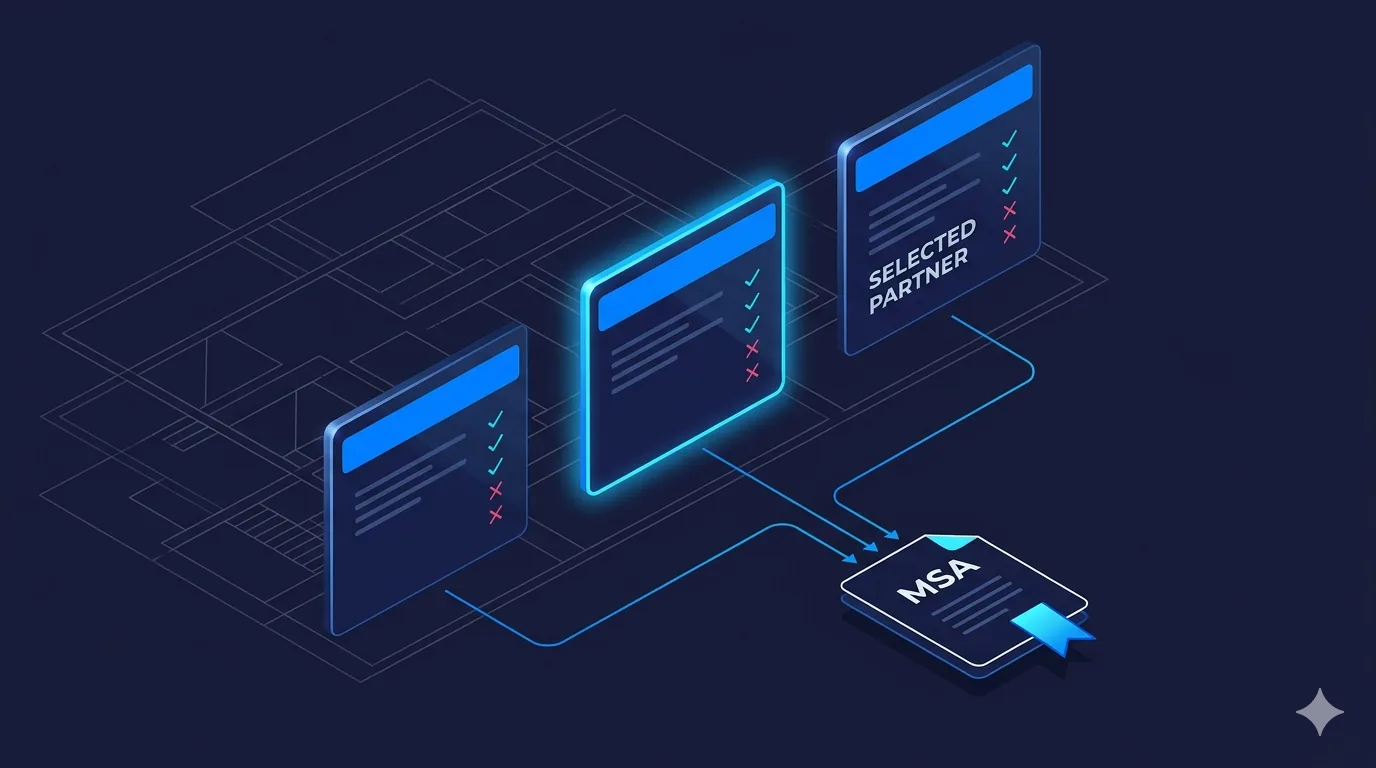
- Run a paid scoping engagement. 1 to 2 weeks, USD 5K to 15K, fixed price. Each vendor delivers an architecture sketch, a team proposal, a timeline, and a list of risks they see. This is the single highest-signal step in the process.
- Talk to two of their reference customers in your industry. Skip the marquee names. Ask about communication, change management, and what they would do differently.
- Run a paid trial week with the winner. Real engineers, real codebase, real PRs. If the trial does not produce shippable code by Friday, the engagement will not produce it later either.
Skip the RFP marathon. A 30-page RFP filters for vendors who are good at writing RFPs, not vendors who are good at building software. The paid scoping engagement filters far better, costs less of everyone's time, and produces real artifacts you keep.
What red flags predict a failed outsourcing engagement?
Patterns we have seen kill projects:
- "Yes" to every scope question. A serious vendor pushes back on bad scope. A vendor who agrees with everything is selling, not engineering.
- Massive team proposed for a small problem. A 12-person team proposed for a 5-person job is a body shop optimizing for revenue, not your outcome.
- No named team in the proposal. "We will assign engineers from our talent pool" means you get whoever is on the bench. Insist on named individuals with LinkedIn profiles before signing.
- Refusal to do a paid trial. Any vendor confident in their team will agree to a 1-week paid trial. Any vendor who refuses is hiding something.
- No technical lead on the call. If the only people you meet during selection are sales and account managers, you will get a body shop experience.
- Hourly rates with no team continuity guarantee. Engineers rotating off your project every 3 months is the offshore body-shop default. Insist on continuity.
- Vague IP clause in the MSA. If "all work product belongs to customer" is missing or qualified, walk away.
- No security or compliance answers. A vendor who cannot describe their security posture in 10 minutes does not have one.
What contract clauses actually matter?
The Master Services Agreement is where most engagements get burned silently. The clauses to review with a lawyer who has done cross-border tech work:
- IP assignment chain. Vendor → engineer → customer. The vendor must have signed IP assignment from every engineer working on your project, and that assignment must flow to you. If the chain breaks, you do not own the code you paid for.
- Source code escrow or weekly handover. Code lives in your GitHub or GitLab from day one. No "we will hand over at the end of the engagement" arrangements.
- Confidentiality and data handling. Specific to your data classes. NDA-style language is not enough.
- Sub-processor list. Every third party the vendor uses (cloud, monitoring, analytics) must be disclosed and approved. Required for SOC 2, ISO 27001, GDPR, and DPDP compliance.
- Audit rights. You can audit their security controls, code review process, and access logs on reasonable notice.
- Right to interview replacements. If the vendor wants to swap an engineer, you interview the replacement before they touch the codebase.
- Termination for convenience with reasonable notice. 30 to 60 days. No long lock-in clauses.
- Compliance pass-through. If you are SOC 2 or ISO 27001 certified, the vendor's controls must meet your evidence requirements.
- For India vendors specifically: GST invoicing, FEMA compliance, FIRC documentation. Your finance and procurement teams need these for clean books and tax credits.
For procurement-side detail on India vendor contracts, see our staff augmentation vs EOR vs India entity post. For our managed model that handles most of the above by default, see India Handled.
How do you structure the engagement so it actually works?
The structures that consistently ship:
| Structure | Best for | Watch out for |
|---|---|---|
| Dedicated team, time and materials | Long-term v1 build with evolving scope | Scope creep without budget guardrails. Set a monthly burn ceiling. |
| Fixed-price milestone, then T&M for v2 | Well-scoped v1 with known requirements | Change requests become friction. Plan a change-budget upfront. |
| Staff augmentation into your team | You already have a tech lead and process | You absorb hiring and retention work. Vendor must guarantee continuity. |
| Build, transfer, operate | You eventually want the team in-house | Transfer clauses must be in the original MSA, not negotiated later. |
For most enterprise web app builds, a dedicated team on time-and-materials with a monthly burn ceiling and quarterly milestone reviews is the right default. Fixed price sounds safer but produces worse software because changes become contract events instead of engineering decisions.
Who needs to own the relationship on your side?
This is the single biggest determinant of success. The outsourced team can be excellent and the project will still fail if nobody on your side owns the technical relationship.
The owner is one of:
- VP Eng or CTO: best when the application is strategic and you are growing the engineering org.
- Staff engineer or principal engineer: best when you have one strong senior who can spend 30 to 50% of their time here.
- Fractional CTO: best when you do not have either of the above and cannot hire one in time.
- Embedded engineering manager from the vendor: second best, but only with a vendor whose EMs you trust. See our India Handled model where this is built in.
What the owner does: reviews architecture decisions, approves senior hires onto the team, runs weekly syncs, holds the vendor accountable to milestones, and translates business priorities into engineering scope. They are not writing code 40 hours a week. They are making sure the team that is writing code is solving the right problem the right way.
If you cannot identify this person before signing, do not sign.
How should you run the first 90 days?
The first 90 days set the trajectory for the entire engagement. The pattern that consistently works:
- Week 1-2: Onboarding and access. SSO, GitHub, AWS or GCP, Slack, design tools, ticket tracker. Security-reviewed laptops or VDI if your compliance regime demands.
- Week 2-4: Architecture sketch and ADRs. The vendor team produces a written architecture document and 3 to 5 architecture decision records (ADRs) for the most consequential choices. Your owner reviews and signs off in writing.
- Week 3-6: First production-shaped deliverable. Not a feature. A real walking skeleton: auth, one entity end-to-end, deployed to staging, with logging and a health check. This proves the team can actually ship.
- Week 6-8: First milestone demo to stakeholders. Real users (or proxy users) click through. Feedback shapes the next milestone.
- Week 9-12: Second milestone, retrospective, scope adjustment. By week 12 you know whether this engagement will work. If it will not, change course now, not at month 6.
What does honest pricing look like?
Indicative monthly burn for a dedicated 8-person team in 2026:
| Region | Monthly burn | 6-month total | What you get |
|---|---|---|---|
| US senior team | USD 130K to 180K | USD 780K to 1.08M | Highest hourly cost, native timezone, slowest to assemble |
| Eastern Europe | USD 70K to 100K | USD 420K to 600K | Strong cultural fit with US/UK, partial timezone overlap, moderate cost |
| India dedicated | USD 38K to 65K | USD 230K to 390K | Deepest hiring pool, biggest cost saving, requires partner discipline |
| India + US lead hybrid | USD 55K to 85K | USD 330K to 510K | Best of both: India build, US-hours technical owner |
Hourly rates below USD 25 for senior engineers are usually too good to be true. They typically mean junior engineers fronted by senior names, no continuity guarantee, or no real engineering management. For Indian developer cost detail, see our 2026 senior developer salary guide and dedicated developer vs freelancer vs agency total cost.
What are the most common outsourcing mistakes?
- No technical owner on the customer side. The vendor is left to make architecture decisions in a vacuum. The result fits the vendor's habits, not your business.
- Skipping the paid trial week. Saves USD 5K to 10K up front, costs USD 100K to 500K when the engagement turns out to be wrong six months in.
- Vague scope at signing. Every change becomes a contract event. Engineering velocity collapses.
- No continuity guarantee. Engineers rotate off every 3 months. You spend the next quarter onboarding the replacements.
- Code lives in vendor's GitHub. You cannot see what is being built in real time, you cannot run your own scans, and the IP transfer at the end becomes an ordeal.
- No retrospectives. Problems compound silently. By the time someone surfaces them, the trust is gone.
- Treating the vendor as a "team you bought" instead of a partner you manage. The vendor is responsible for delivery. You are responsible for direction. Confusing the two breaks both sides.
How do you compare vendor categories honestly?
For the side-by-side of staff augmentation, EOR, and India entity models, see our staff augmentation vs EOR vs India entity post. For comparison with marketplace models, see Toptal vs Andela vs Turing vs Workforce Next. For why managed models beat raw freelancing for production work, see dedicated developer vs freelancer vs agency total cost.
Where does Workforce Next fit in?
We run a managed dedicated team model out of India for enterprise customers in the US, UK, EU, and APAC. Every engagement includes named senior engineers, an embedded engineering manager, source code in your repo from day one, GST and FEMA-compliant invoicing, IP assignment chain documented, and a paid trial week before commitment.
If you are scoping an outsourced enterprise web app build and want a partner who pushes back on bad scope, see our India Handled model, browse full-stack developers or backend engineers, or talk to us about your project. We will tell you honestly whether outsourcing is the right move and which structure fits your case.