
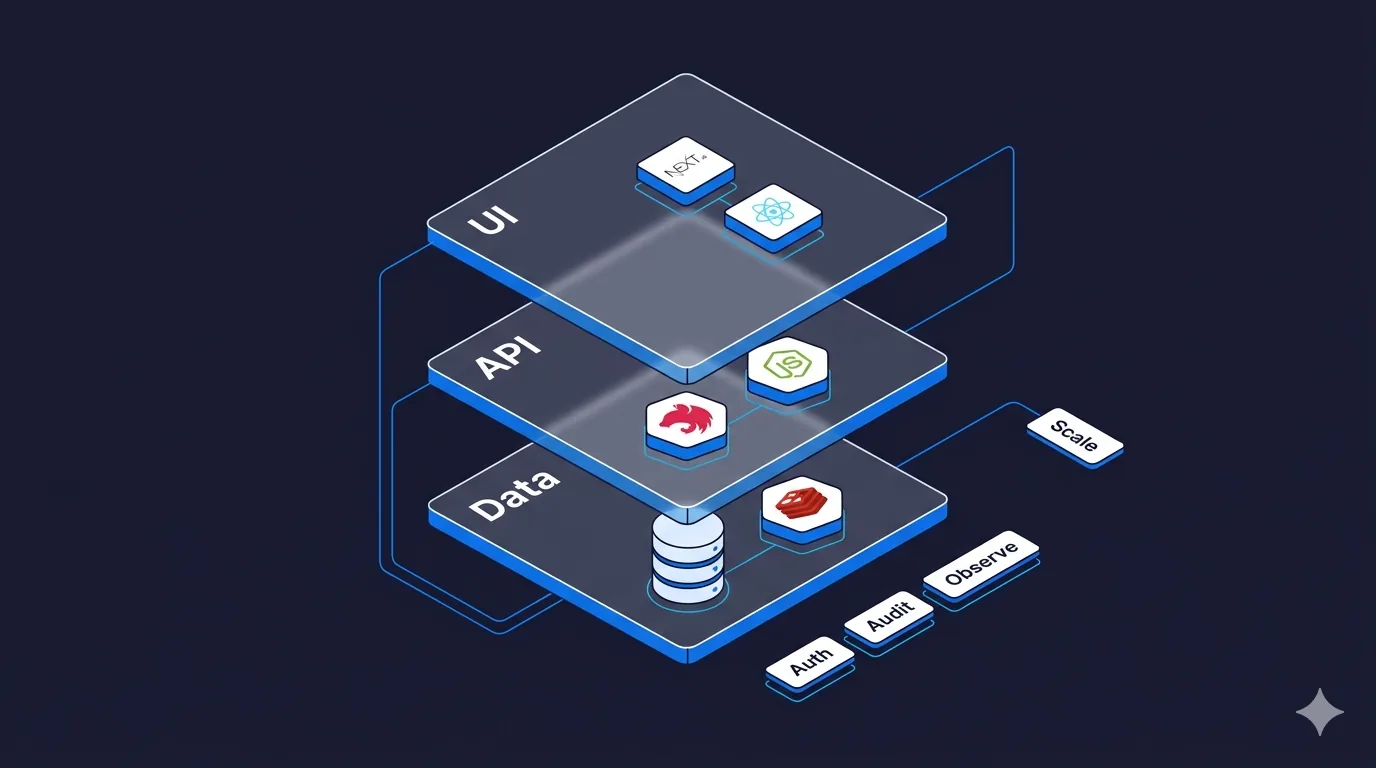
Enterprise web application development is the discipline of building web systems that hundreds or thousands of internal users, customers, and partners depend on every day. It is not the same as building a marketing site or a single-page SaaS demo. The constraints are different, the team shape is different, and the cost of cutting corners is much higher because real money, real compliance, and real users sit on top of what you ship.
This guide walks through what enterprise web application development actually involves in 2026: the scope, the architecture, the stack, the team, the timeline, the cost, and the patterns that separate projects that ship from projects that get rewritten. If you need engineers for any of this, see our full-stack developers, backend engineers, or Node.js engineers.
What counts as an enterprise web application?
"Enterprise" is overused. For this guide, an enterprise web application has at least four of these properties:
- Multiple user roles with different permissions. Admin, manager, end user, support, finance. Authorization is a real subsystem, not an afterthought.
- Multi-tenant or multi-organization data. Customers see their own data, never each other's. Tenant isolation has to be airtight.
- Integration with other internal or external systems. SSO, payments, ERP, CRM, identity providers, webhooks, partner APIs.
- Compliance or regulatory requirements. SOC 2, ISO 27001, GDPR, HIPAA, PCI, DPDP, sector-specific rules.
- Operational SLOs. Defined uptime, response time, and error budgets that the business actually tracks.
- Audit trails and reporting. Who did what, when, from where, with tamper-evident storage.
- A roadmap measured in years, not months. The system will outlive its first three engineering teams.
If your project hits four or more, treat it as an enterprise build from day one. Architecture and process choices that are fine for a quick MVP become expensive to undo later.
What is the typical scope of an enterprise web application?
The scope falls into seven layers, and you need someone owning each one:
- Front-end UI. The web app users actually see. Usually Next.js or React with TypeScript in 2026, with design system components, accessibility, and internationalization built in.
- Backend APIs. REST or GraphQL endpoints powering the front end and external integrations. Built in Node.js (NestJS, Fastify), Java (Spring, Quarkus), .NET, or Python (FastAPI, Django) depending on the team.
- Identity and authorization. SSO, MFA, role-based access, fine-grained permissions, audit logs.
- Data layer. A relational database (PostgreSQL is the default in 2026), often with Redis for caching, plus object storage for files and a search index for query-heavy features.
- Async work and integration glue. Background jobs, scheduled tasks, webhook processors, ETL pipelines, message queues.
- Observability and operations. Logs, metrics, distributed tracing, alerting, on-call rotation, incident response.
- Security and compliance. OWASP-aligned controls, dependency hygiene, secrets management, encryption in transit and at rest, audit-ready evidence.
Skipping any of these layers does not save time, it just defers the work to a worse time. The most common painful rewrites we see come from teams that treated identity, observability, or security as Phase 2 problems.
What is the right tech stack for enterprise web application development in 2026?
There is no one-size-fits-all stack, but there are a few combinations that consistently hold up in production:
| Layer | Default 2026 picks | When to deviate |
|---|---|---|
| Front-end framework | Next.js 15, React 19 | Remix or SvelteKit for lighter teams; Angular when an existing estate runs it |
| Language | TypeScript everywhere | Rare to deviate in 2026 |
| API runtime | Node.js with NestJS or Fastify | Java/Spring or .NET when an existing estate runs them; Go for latency-critical paths |
| Database | PostgreSQL, often via Prisma or Drizzle | MongoDB when document fit is real; SQL Server inside Microsoft shops |
| Cache and queues | Redis (BullMQ for jobs) | Kafka for high-throughput event streams; SQS in AWS-native shops |
| Identity | Auth0, Clerk, AWS Cognito, or in-house OIDC | Customer-facing scale or specific compliance may force in-house |
| Hosting | Vercel for the front-end, AWS/GCP/Azure for the backend (Kubernetes or serverless) | On-prem or sovereign cloud for regulated workloads |
| Observability | OpenTelemetry plus Datadog, New Relic, or Grafana stack | Self-hosted Prometheus + Loki + Tempo when cloud bills demand it |
For a deeper view of when to choose Node.js vs Java vs Go for the API tier, read Node.js vs Java vs Go for enterprise backends. For the framework choice within Node.js, see Express vs Fastify vs NestJS.
What architecture patterns hold up in production?
Three patterns dominate enterprise web app architecture in 2026, in order of how often we recommend them:
- Modular monolith with clean module boundaries. One deployable, but internally split into bounded contexts (billing, identity, scheduling, reporting). NestJS modules or Spring profiles. This is the right default for most enterprise builds. It gives you most of the benefits of microservices without the operational tax.
- Microservices when the boundaries are real. Multiple teams shipping independently, services with different scaling profiles, or compliance boundaries that demand process isolation. See our Node.js microservices guide for the patterns that survive.
- BFF + headless services. A backend-for-frontend layer powering Next.js or React clients, with shared headless services beneath for billing, identity, and reporting. Common when there is a web app plus a mobile app plus partner APIs sharing the same domain logic.
Anti-patterns we see almost weekly: 5 microservices that should have been 1 monolith, services sharing a database, sync HTTP chains across more than three hops, and BFFs that grew until they were monoliths in disguise.
What does the team shape look like?
For a real enterprise web app, the minimum viable team is 6 to 10 people. Smaller teams ship slower than they think because cross-cutting concerns (security, observability, design system, code review) eat into individual contributor time.
| Role | Count | What they own |
|---|---|---|
| Tech lead / architect | 1 | Architecture decisions, hiring bar, RFCs, incident leadership |
| Frontend engineer | 2 | UI, design system integration, accessibility, performance |
| Backend engineer | 2 to 3 | APIs, integrations, auth, data layer, async work |
| DevOps / SRE | 1 | CI/CD, infra, observability, security baseline, on-call tooling |
| QA / SDET | 1 | Test strategy, automation, release validation, regression coverage |
| Product / project manager | 1 | Scope, roadmap, stakeholder alignment, release planning |
| Designer | 0.5 to 1 | UX flows, visual design, design system maintenance |
If you do not have a fractional or full-time PM owning scope and stakeholders, your engineers will spend 30% of their time doing it badly. See fractional project manager if you need that role without a full-time hire.
How long does enterprise web application development actually take?
Honest ranges, based on dozens of builds we have staffed:
| Project shape | Team size | MVP timeline | V1 timeline |
|---|---|---|---|
| Internal tool, single tenant, light integrations | 3 to 5 | 2 to 3 months | 4 to 6 months |
| Multi-tenant SaaS, moderate integrations | 5 to 8 | 3 to 5 months | 6 to 9 months |
| Regulated multi-tenant platform (fintech, healthtech) | 7 to 10 | 4 to 6 months | 9 to 14 months |
| Replacement of an existing legacy system | 8 to 12 | 6 to 9 months (parallel run) | 12 to 24 months (full cutover) |
Anything claiming "enterprise app in 8 weeks" is either MVP-shaped (and you will rewrite it) or it is not enterprise. Realistic expectations save the project.
What does enterprise web application development cost in 2026?
Cost depends almost entirely on team composition and geography. Indicative ranges for a 6-month V1 build:
| Team blend | Monthly burn | 6-month total |
|---|---|---|
| US-only senior team (8 people) | USD 130K to 180K | USD 780K to 1.08M |
| Eastern Europe team (8 people) | USD 70K to 100K | USD 420K to 600K |
| India dedicated team (8 people) | USD 38K to 65K | USD 230K to 390K |
| Hybrid (US lead + India build, 8 people) | USD 55K to 85K | USD 330K to 510K |
For India team cost detail, see our 2026 senior developer salary guide and managed offshore team page. Total cost of ownership beyond hourly rate is covered in dedicated developer vs freelancer vs agency total cost.
How do you bake security and compliance in from day one?
Retrofitting security is 5 to 10 times more expensive than building it in. The non-negotiable baseline:
- Identity done right. SSO with SAML or OIDC, MFA for privileged users, short-lived tokens, revocable sessions.
- Authorization on every endpoint. Default deny. Centralize the policy decisions, not the checks.
- Tenant isolation enforced at the data layer. Row-level security in PostgreSQL or schema-per-tenant where the model fits. Never trust app-layer filtering alone.
- Input validation at the framework boundary. zod, class-validator, or JSON schema. Validate everything the user, partner, or webhook sends.
- Secrets in a secret manager. Vault, AWS Secrets Manager, Doppler. Not in env vars committed to anything.
- Dependency hygiene. SCA on every build (Snyk, Socket, npm audit). Block high and critical CVEs.
- Audit logs. Tamper-evident, queryable, retained per your compliance regime.
- Encryption in transit and at rest. TLS everywhere, KMS-backed keys for sensitive columns.
- Incident response runbooks. Top 5 incident classes, explicit steps, tabletop exercises every quarter.
For Node.js-specific security depth, read our Node.js security checklist. For LLM-augmented apps, the OWASP LLM Top 10 implementation checklist applies.
How do you handle observability and operations from day one?
The minimum bar for any enterprise web app:
- Structured JSON logging with request IDs, correlation IDs, and tenant IDs on every line.
- Distributed tracing via OpenTelemetry, instrumented at the framework layer.
- Metrics for RPS, error rate, p50/p95/p99 latency per endpoint, plus runtime metrics like event loop lag (Node.js) or GC pause time.
- Per-service SLOs with error budgets, not vanity uptime numbers.
- On-call rotation with runbooks for the top 5 failure modes per service.
- Synthetic monitoring on critical user journeys, alerting before users notice.
For deeper Node.js performance and scaling work, see our Node.js performance and scaling checklist.
What are the most common enterprise web app development mistakes?
- Treating identity, observability, or security as Phase 2. They are foundational. Bolting them on later costs 5 to 10 times more.
- Splitting into microservices too early. Three services for a 5-engineer team is the worst of both worlds.
- Sharing a database across services. Coupling masquerading as decoupling. Every schema change becomes a multi-team coordination problem.
- No PM or fractional PM. Engineers spend 30% of their time doing project management badly. Hire one or rent one.
- Vendor lock-in by accident. Picking a cloud-specific service for every layer because it is "easier" leaves you stuck when bills grow or compliance demands movement.
- Skipping the tech lead. A team of senior engineers without a single owner of architecture decisions ends up with five competing patterns and no coherence.
- Building before scoping. Two weeks of disciplined scoping saves three months of rework. Always.
How should you approach outsourcing or staffing an enterprise web app?
Three honest options:
- Hire a full in-house team. Best when the application is your core product and you can afford US/EU senior salaries. Slowest to assemble, highest control, highest cost.
- Hire a managed offshore team. A pre-vetted dedicated team from India or Eastern Europe, with an embedded engineering manager and shared context documentation. Fastest to assemble, 60 to 70% cost savings vs in-house, requires partner discipline. See our managed offshore team model.
- Use a consulting firm for build, then transition. Best when the team needs to ship a V1 fast and then move to in-house ownership. Higher cost during build, smooth handoff if the contract is structured well.
For the procurement-side decision, read staff augmentation vs EOR vs India entity. For comparison with other vendor categories, see Toptal vs Andela vs Turing vs Workforce Next.
Where does Workforce Next fit in?
We staff enterprise web application development teams from India for companies in the US, UK, EU, and APAC. Most placements are senior or lead engineers with 5 to 10 years of production experience across the stack. Common shapes are full pods (frontend, backend, DevOps, QA, PM) and individual specialists who slot into your existing team.
If you are scoping an enterprise web app build or trying to staff one in flight, see our full-stack developers, backend engineers, Node.js engineers, frontend engineers, or DevOps engineers. Or talk to us about your project and we will help you scope team shape, timeline, and budget honestly.